Application
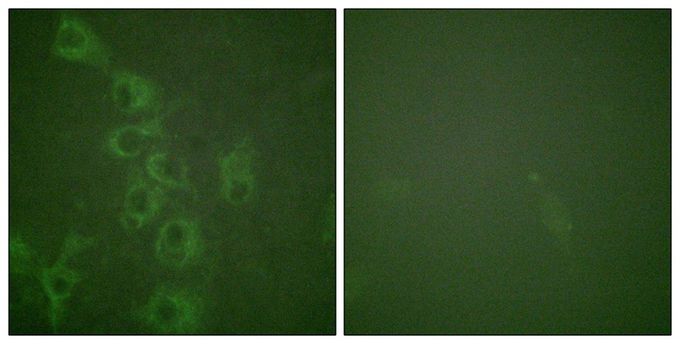
Immunofluorescence staining of methanol-fixed HuvEc cells using Histamine H1 Receptor (Phospho-Ser398) Antibody.| Product Name | HRH1 (phospho Ser398) antibody |
|---|---|
| Antibody Type | Primary Antibodies |
| Product description | Rabbit Polyclonal antibody to HRH1 (phospho Ser398)Histamine is a ubiquitous messenger molecule released from mast cells, enterochromaffin-like cells, and neurons. Its various actions are mediated by histamine receptors H1, H2, H3 and H4. The protein encoded by this gene is an integral membrane protein and belongs to the G protein-coupled receptor superfamily. It mediates the contraction of smooth muscles, the increase in capillary permeability due to contraction of terminal venules, the release of catecholamine from adrenal medulla, and neurotransmission in the central nervous system. It has been associated with multiple processes, including memory and learning, circadian rhythm, and thermoregulation. It is also known to contribute to the pathophysiology of allergic diseases such as atopic dermatitis, asthma, anaphylaxis and allergic rhinitis. Multiple alternatively spliced variants, encoding the same protein, have been identified. [provided by RefSeq, Jan 2015] |
| Immunogen | Peptide sequence around phosphorylation site of Serine 398(S-H-S(p)-R-Q) derived from Human Histamine H1 Receptor . |
| Modification | p-Ser398 |
| Clonality | Polyclonal |
|---|---|
| Isotype | IgG |
| Host Species | Rabbit |
| Tested Applications | ICC/IF |
| IF: 1:100 - 1:200: |
|
| Species Reactivity | Human |
| Concentration | 1mg/ml (Please refer to the vial label for the specific concentration) |
| Purification | Affinity purified |
| Gene Synonyms | HH1R H1-R hisH1 H1R HRH1 histamine receptor H1 |
|---|---|
| Target | HRH1 (phospho Ser398) |
| Tissue Specificity | The antibody detects endogenous levels of Histamine H1 Receptor only when phosphorylated at serine 398. |
Application
Immunofluorescence staining of methanol-fixed HuvEc cells using Histamine H1 Receptor (Phospho-Ser398) Antibody.| Application Notes | IF: 1:100 - 1:200: |
|---|
| Form | Liquid |
|---|---|
| Storage Instructions | Store at -20˚C/1 year |
| Storage Buffer | Rabbit IgG in phosphate buffered saline (without Mg2+ and Ca2+), pH 7.4, 150mM NaCl, 0.02% sodium azide and 50% glycerol. |


