Application
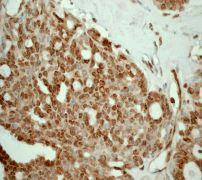
B. Immunohistochemical staining of paraffin-embedded human ovarian carcinoma using anti-HSF1 RabMAb (cat. #).Application
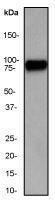
A. Western blot analysis on HeLa cell lysate using anti-HSF1 RabMAb (cat. # ).| Product Name | HSF1 antibody , C-term |
|---|---|
| Antibody Type | Primary Antibodies |
| Product description | Rabbit monoclonal antibody [EP1710Y] to HSF1Human cells respond to heat stress by inducing the binding of a pre-existing transcriptional activator (heat shock factor, HSF) to DNA . Induction of heat shock protein (HSP) gene expression by stress is initiated by binding of HSF1 to HSP gene promoters to increase their transcription. The cytoprotective functions of these HSPs are essential for cell survival, and thus it is critical that inducible HSP gene expression be executed rapidly and efficiently. There is an interaction between heat shock factor 1 (HSF1) and symplekin, a protein known to form a complex with the polyadenylation factors CstF and CPSF. HSF1-symplekin complexes are detected only after stress treatment, and these two proteins co-localize in punctate nuclear structures in stressed cells . A chaperone/Hsp functioning as repressor of heat shock transcription factor (HSF) could make activation of hsp genes dependent on protein unfolding. It has been concluded that Hsp90, by itself and/or associated with multichaperone complexes, is a major repressor of HSF1 . |
| Immunogen | A synthetic peptide corresponding to residues near the C-terminus of human HSF1 was used as an immunogen. |
| Clonality | Monoclonal |
|---|---|
| Isotype | IgG |
| Clone Number | EP1710Y |
| Host Species | Rabbit |
| Tested Applications | FACSICC/IFIHC-PIPWB |
| For WB: Use at a dilution of 1:20,000 - 50,000: |
|
| Species Reactivity | Human |
| Concentration | 1mg/ml |
| Gene Synonyms | HSF1 HSTF1 |
|---|---|
| Target | HSF1 |
| Molecular Weight(MW) | 82 (note) |
Application
B. Immunohistochemical staining of paraffin-embedded human ovarian carcinoma using anti-HSF1 RabMAb (cat. #).
Application
A. Western blot analysis on HeLa cell lysate using anti-HSF1 RabMAb (cat. # ).| Application Notes | For WB: Use at a dilution of 1:20,000 - 50,000: |
|---|
| Form | Liquid |
|---|---|
| Storage Instructions | Store at -20 °C. Stable for 12 months from date of receipt. |
| Storage Buffer | 50 mM Tris-Glycine (pH 7.4), 0.15 M NaCl, 40% Glycerol, 0.01% sodium azide and 0.05% BSA. |


