Application
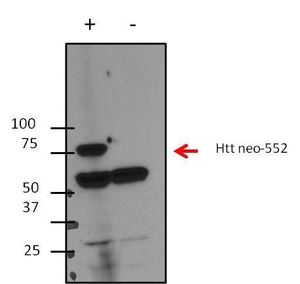
WB analysis of lysates from cells over-expressed recombinant HTT fragment l(left) and empty vector control (right) using Huntingtin (neoepitope 552) antibody [4-13] at a dilution of 1:500.| Product Name | Huntingtin (neoepitope 552) antibody |
|---|---|
| Antibody Type | Primary Antibodies |
| Product description | Mouse Monoclonal antibody [4-13] to Huntingtin (neoepitope 552)Huntingtin is a disease gene linked to Huntington's disease, a neurodegenerative disorder characterized by loss of striatal neurons. This is thought to be caused by an expanded, unstable trinucleotide repeat in the huntingtin gene, which translates as a polyglutamine repeat in the protein product. A fairly broad range in the number of trinucleotide repeats has been identified in normal controls, and repeat numbers in excess of 40 have been described as pathological. The huntingtin locus is large, spanning 180 kb and consisting of 67 exons. The huntingtin gene is widely expressed and is required for normal development. It is expressed as 2 alternatively polyadenylated forms displaying different relative abundance in various fetal and adult tissues. The larger transcript is approximately 13.7 kb and is expressed predominantly in adult and fetal brain whereas the smaller transcript of approximately 10.3 kb is more widely expressed. The genetic defect leading to Huntington's disease may no |
| Immunogen | Synthetic peptide conjugated to KLH via cysteine corresponding to residues CSDPAMDLND (544-552) of Human HTT. |
| Clonality | Monoclonal |
|---|---|
| Isotype | IgG |
| Clone Number | 4-13 |
| Host Species | Mouse |
| Tested Applications | ICC/IFIHCWB |
| IF: 2.5ug/ml. IHC: 2.5ug/ml. WB: 1:500 - 1:1000: |
|
| Species Reactivity | HumanMouse |
| Concentration | 1mg/ml (Please refer to the vial label for the specific concentration) |
| Purification | Affinity purified |
| Gene Synonyms | huntingtin IT15 HD HTT |
|---|---|
| Target | Huntingtin (neoepitope 552) |
Application
WB analysis of lysates from cells over-expressed recombinant HTT fragment l(left) and empty vector control (right) using Huntingtin (neoepitope 552) antibody [4-13] at a dilution of 1:500.| Application Notes | IF: 2.5ug/ml. IHC: 2.5ug/ml. WB: 1:500 - 1:1000: |
|---|
| Form | Liquid |
|---|---|
| Storage Instructions | -20°C |
| Storage Buffer | PBS with 1mg/ml BSA and 0.05% sodium azide |


