Application
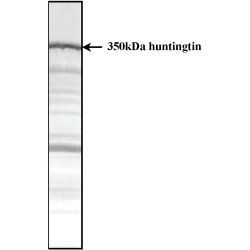
WB analysis of normal human cerebral cortex tissue lysate using Huntingtin antibody [HDC8A4].| Product Name | Huntingtin antibody |
|---|---|
| Antibody Type | Primary Antibodies |
| Product description | Mouse monoclonal antibody [HDC8A4] to HuntingtinHuntingtin is a disease gene linked to Huntington's disease, a neurodegenerative disorder characterized by loss of striatal neurons. This is thought to be caused by an expanded, unstable trinucleotide repeat in the huntingtin gene, which translates as a polyglutamine repeat in the protein product. A fairly broad range in the number of trinucleotide repeats has been identified in normal controls, and repeat numbers in excess of 40 have been described as pathological. The huntingtin locus is large, spanning 180 kb and consisting of 67 exons. The huntingtin gene is widely expressed and is required for normal development. It is expressed as 2 alternatively polyadenylated forms displaying different relative abundance in various fetal and adult tissues. The larger transcript is approximately 13.7 kb and is expressed predominantly in adult and fetal brain whereas the smaller transcript of approximately 10.3 kb is more widely expressed. The genetic defect leading to Huntington's disease may no |
| Immunogen | Recombinant protein corresponding to amino acids 2703 - 2911 of huntingtin. |
| Clonality | Monoclonal |
|---|---|
| Isotype | IgG1 |
| Clone Number | HDC8A4 |
| Host Species | Mouse |
| Tested Applications | IHC-FIPWB |
| IHC-F:1:50~1:100 IP:1:100~1:500 WB:1:500~1:2000 Notes:Optimal dilutions/concentrations should be determined by the researcher. |
|
| Species Reactivity | HumanMouseRabbit |
| Concentration | 1mg/ml |
| Purification | Affinity purified |
| Gene Synonyms | IT15 huntingtin HTT HD |
|---|---|
| Target | Huntingtin |
| Tissue Specificity | This antibody recognizes both denatured and native huntingtin in human brain. |
Application
WB analysis of normal human cerebral cortex tissue lysate using Huntingtin antibody [HDC8A4].| Application Notes | IHC-F:1:50~1:100 IP:1:100~1:500 WB:1:500~1:2000 Notes:Optimal dilutions/concentrations should be determined by the researcher. |
|---|
| Form | Liquid |
|---|---|
| Storage Instructions | Store at +4°C or at -20°C if preferred. This product should be stored undiluted. Storage in frost free freezers is not recommended. Avoid repeated freezing and thawing as this may denature the antibody. Should this product contain a precipitate we recommend microcentrifugation before use. |
| Storage Buffer | Phosphate buffered saline containing 0.09% Sodium Azide |


