Application
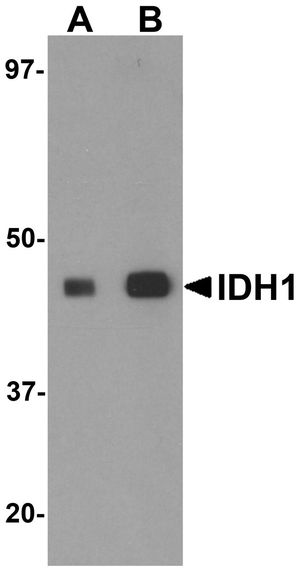
Western blot analysis of IDH1 in HepG2 cell lysate with IDH1 antibody at (A) 1 and (B) 2 ug/mL.| Product Name | IDH1 antibody |
|---|---|
| Antibody Type | Primary Antibodies |
| Product description | Rabbit Polyclonal antibody to IDH1Isocitrate dehydrogenases catalyze the oxidative decarboxylation of isocitrate to 2-oxoglutarate. These enzymes belong to two distinct subclasses, one of which utilizes NAD(+) as the electron acceptor and the other NADP(+). Five isocitrate dehydrogenases have been reported: three NAD(+)-dependent isocitrate dehydrogenases, which localize to the mitochondrial matrix, and two NADP(+)-dependent isocitrate dehydrogenases, one of which is mitochondrial and the other predominantly cytosolic. Each NADP(+)-dependent isozyme is a homodimer. The protein encoded by this gene is the NADP(+)-dependent isocitrate dehydrogenase found in the cytoplasm and peroxisomes. It contains the PTS-1 peroxisomal targeting signal sequence. The presence of this enzyme in peroxisomes suggests roles in the regeneration of NADPH for intraperoxisomal reductions, such as the conversion of 2, 4-dienoyl-CoAs to 3-enoyl-CoAs, as well as in peroxisomal reactions that consume 2-oxoglutarate, namely the alpha-hydroxylation of phytanic acid. The cytoplasmic enzyme serves a significant role in cytoplasmic NADPH production. Alternatively spliced transcript variants encoding the same protein have been found for this gene. [provided by RefSeq, Sep 2013] |
| Immunogen | IDH1 antibody was raised against a 13 amino acid synthetic peptide near the carboxy terminus of human IDH1. |
| Clonality | Polyclonal |
|---|---|
| Isotype | IgG |
| Host Species | Rabbit |
| Tested Applications | ELISA,WB |
| WB: 1 - 2 ug/ml | |
| Species Reactivity | Human |
| Concentration | 1mg/ml (Please refer to the vial label for the specific concentration) |
| Purification | Affinity purified |
| Gene Synonyms | IDH , isocitrate dehydrogenase 1 (NADP+), soluble , HEL-216 , IDP , HEL-S-26 , IDPC , IDCD , PICD |
|---|---|
| Target | IDH1 |
Application
Western blot analysis of IDH1 in HepG2 cell lysate with IDH1 antibody at (A) 1 and (B) 2 ug/mL.| Application Notes | WB: 1 - 2 ug/ml |
|---|
| Form | Liquid |
|---|---|
| Storage Instructions | Be stored at 4oC for three months and -20oC, stable for up to one year. As with all antibodies care should be taken to avoid repeated freeze thaw cycles. Antibodies should not be exposed to prolonged high temperatures. |
| Storage Buffer | PBS containing 0.02% sodium azide. |


