Application
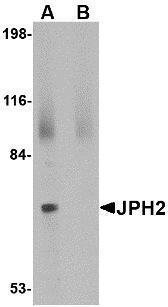
Western blot analysis of JPH2 in 293 cell lysate with JPH2 antibody at 2 ug/ml in (A) the absence and (B) the presence of blocking peptide.| Product Name | JPH2 antibody |
|---|---|
| Antibody Type | Primary Antibodies |
| Product description | Rabbit polyclonal antibody to JPH2Junctional complexes between the plasma membrane (PM) and endoplasmic/sarcoplasmic reticulum (ER/SR) are a common feature of all excitable cell types and mediate cross talk between cell surface and intracellular ion channels. Junctophilins (JPs) are important components of the junctional complexes. JPs are composed of a carboxy-terminal hydrophobic segment spanning the ER/SR membrane and a remaining cytoplasmic domain that shows specific affinity for the PM. Four JPs have been identified as tissue-specific subtypes derived from different genes: JPH1 is expressed in skeletal muscle, JPH2 is detected throughout all muscle cell types, and JPH3 and JPH4 are predominantly expressed in the brain and contribute to the subsurface cistern formation in neurons. JPH2-null mice died of embryonic cardiac arrest and human patients with mutations in the JPH2 gene showed hypertrophic cardiomyopathy, demonstrating the importance of this protein. Multiple isoforms of JPH2 are known to exist. |
| Clonality | Polyclonal |
|---|---|
| Host Species | Rabbit |
| Tested Applications | ELISAWB |
| WB:1:500~1:2000 Notes:Optimal dilutions/concentrations should be determined by the researcher. |
|
| Species Reactivity | HumanMouseRat |
| Concentration | 1mg/ml |
| Purification | Affinity purified |
| Gene Synonyms | JPH2 JP2 JP-2 Junctophilin2 Junctophilin 2 JP 2 |
|---|---|
| Target | JPH2 |
| Tissue Specificity | This antibody is specific for JPH2 C-Terminus |
Application
Western blot analysis of JPH2 in 293 cell lysate with JPH2 antibody at 2 ug/ml in (A) the absence and (B) the presence of blocking peptide.| Positive Control | Blocking Peptide: Cat.No. GTX85367-PEP - JPH2 Peptide Lysates: Cat. No. GTX27902 - 293 Cell Lysate |
|---|---|
| Application Notes | WB:1:500~1:2000 Notes:Optimal dilutions/concentrations should be determined by the researcher. |
| Form | Liquid |
|---|---|
| Storage Instructions | Keep as concentrated solution. Aliquot and store at -20ºC or below. Avoid multiple freeze-thaw cycles. |
| Storage Buffer | PBS containing 0.02% sodium azide |


