Application
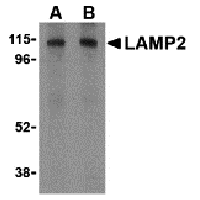
Western blot analysis of LAMP-2 in HepG2 cell lysate with LAMP-2 antibody at (A) 1 and (B) 2 μg/mL.| Product Name | LAMP2 antibody |
|---|---|
| Antibody Type | Primary Antibodies |
| Product description | Rabbit polyclonal to LAMP2Autophagy, the process of bulk degradation of cellular proteins through an autophagosomic-lysosomal pathway is important for normal growth control and may be defective in tumor cells. It is involved in the preservation of cellular nutrients under starvation conditions as well as the normal turnover of cytosolic components (1,2) and is negatively regulated by TOR (Target of rapamycin) (3). LAMP-2, a highly glycosylated protein associated with the lysosome (4), has recently been shown to be important in autophagy as mice deficient in this protein failed to convert autophagic vacuoles into vacuoles (5) leading to impaired degradation of long-lived proteins. This correlates with the finding that human LAMP-2 deficiency causing DanonOs disease is associated with the accumulation of autophagic material in striated myocytes (6). LAMP-2 exists in multiple isoforms (7). |
| Immunogen | Human LAMP-2 Peptide |
| Clonality | Polyclonal |
|---|---|
| Isotype | IgG |
| Host Species | Rabbit |
| Tested Applications | WB |
| For ICC: Use at a concentration of 10 µg/ml. For WB: Use at a concentration of 1-2 µg/ml. Optimal dilutions/concentrations should be determined by the end user.: |
|
| Species Reactivity | HumanMouse |
| Concentration | 1mg/ml (Please refer to the vial label for the specific concentration) |
| Purification | Affinity purified |
| Gene Synonyms | CD107b LAMPB LGP110 |
|---|---|
| Target | LAMP2 |
Application
Western blot analysis of LAMP-2 in HepG2 cell lysate with LAMP-2 antibody at (A) 1 and (B) 2 μg/mL.| Positive Control | HepG2 cell lysate |
|---|---|
| Application Notes | For ICC: Use at a concentration of 10 µg/ml. For WB: Use at a concentration of 1-2 µg/ml. Optimal dilutions/concentrations should be determined by the end user.: |
| Form | Liquid |
|---|---|
| Storage Instructions | Keep as concentrated solution, aliquot and store at 4°C. Do not freeze. |
| Storage Buffer | PBS, pH7.2 containing 0.02% sodium azide |


