Application
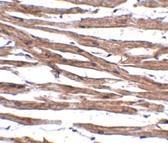
Immunohistochemistry of MAK10 in human heart tissue with MAK10 antibody at 5 ug/ml.Application
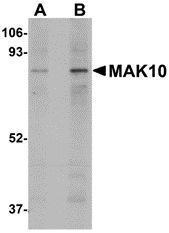
Western blot analysis of MAK10 in mouse heart tissue lysate with MAK10 antibody at (A) 1 and (B) 2 ug/ml.| Product Name | MAK10 antibody |
|---|---|
| Antibody Type | Primary Antibodies |
| Product description | Rabbit polyclonal antibody to MAK10The MAK10 gene encodes a 733-amino acid protein with several regions of similarity to T cell receptor alpha-subunit V (variable) regions in yeast. The mammalian homologue of yeast MAK10, also known as EGAP, is one subunit of a novel N-terminal acetyltransferase (NAT) that is highly conserved among vertebrate species. It is expressed in a variety of tissues in the developing rat embryo but restricted in expression in the adult, remaining detectable only in tissues undergoing continual cell renewal or in cells responding to pathological injury. The MAK10-NAT complex is an essential regulatory enzyme controlling the function of a subset of proteins required for embryonic growth control and vessel development. This complex functionally co-assembles in mammalian cells to regulate cell proliferation and is essential for embryonic development, at least in part through the regulation of target of rapamycin (TOR) signaling events. At least two isoforms of MAK10 are known to exist. |
| Clonality | Polyclonal |
|---|---|
| Host Species | Rabbit |
| Tested Applications | ELISAIHC-PWB |
| Species Reactivity | HumanMouseRat |
| Concentration | 1mg/ml |
| Purification | Affinity purified |
| Gene Synonyms | amino-acid N-acetyltransferase subunit, Embryonic growth-associated protein homolog, EGAP, Embryonic growthassociated protein homolog, aminoacid Nacetyltransferase subunit, MAK10 |
|---|---|
| Target | MAK10 |
| Tissue Specificity | This antibody is specific for MAK10 Internal |
Application
Immunohistochemistry of MAK10 in human heart tissue with MAK10 antibody at 5 ug/ml.
Application
Western blot analysis of MAK10 in mouse heart tissue lysate with MAK10 antibody at (A) 1 and (B) 2 ug/ml.| Form | Liquid |
|---|---|
| Storage Instructions | Keep as concentrated solution. Aliquot and store at -20ºC or below. Avoid multiple freeze-thaw cycles. |
| Storage Buffer | PBS containing 0.02% sodium azide |


