Application
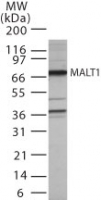
Western bot analysis of MALT1 in Jurkat cell lysate using at 0.5 ug/ml.| Product Name | MALT1 antibody |
|---|---|
| Antibody Type | Primary Antibodies |
| Product description | Rabbit polyclonal to MALT1MALT1 was independently identified as a member of the human paracaspase family and an interacting partner of B cell lymphoma. Two alternatively spliced transcript variants encoding different isoforms (a and b) have been described for the MALT1 gene.Human MALT isoform a is an amino acid protein of 824 amino acids, and human MALT2 isoform b is an amino acid protein of 813 amino acids. MALT1 is thought to play a role in NFkappaB signaling by enchancing NF kappaB activation through interaction with Bcl10. Interaction between Malt1 and Bcl10 mediates IKK activation in vitro through facilitatiing the ubiquitination of NEMO by the ubiquitin conjugating enzyme UBC13. Four recurrent chromosomal translocations have been described in non Hodgkin B cell lymphoma of the mucosa associated lymphoid issue (MALT) type. Two of them, t(14;18)(q32;q21) and t(11;18)(q21;q21), are found in 30% to 50% of extranodal MALT lymphomas. The first translocation juxtaposes the MALT1 gene to the IgH promoter region, resulting in the deregulation of MALT1 expression, whereas the second translocation generates a fusion between MALT1 and the inhibitor of apoptosis gene API2 (cIAP2/HIAP1). The other two much rarer translocations, t(1;14)(p22;q32)and t(1;2)(p22;p12), target Bcl10 gene on the short arm of chromosome 1. Translocations involving Bcl10 and Malt1 may lead to elevated NFkappaB activity in MALT B cell lymphoma. |
| Immunogen | Synthetic peptide: ELLDQAPEGRGWRRL, corresponding to amino acids 43-57 of Human MALT1. |
| Clonality | Polyclonal |
|---|---|
| Isotype | IgG |
| Host Species | Rabbit |
| Tested Applications | WB |
| WB: Use at a concentration of 0.5 - 2 μg/ml. Detects a band of approximately 68 kDa. Optimal dilutions/concentrations should be determined by the end user. | |
| Species Reactivity | Human |
| Concentration | 0.5mg/ml |
| Purification | Affinity purified |
| Gene Synonyms | Q9UDY8, MLT, 604860, 10892, MLT1, DKFZp434L132, MALT1 |
|---|---|
| Target | MALT1 |
| Cellular Localization | Cytoplasmic |
Application
Western bot analysis of MALT1 in Jurkat cell lysate using at 0.5 ug/ml.| Application Notes | WB: Use at a concentration of 0.5 - 2 μg/ml. Detects a band of approximately 68 kDa. Optimal dilutions/concentrations should be determined by the end user. |
|---|
| Form | Liquid |
|---|---|
| Storage Instructions | Keep as concentrated solution. Store at 4ºC short term. For extended storage aliquot and store at -20ºC or below. Avoid freeze-thaw cycles. |
| Storage Buffer | Preservative: 0.05% Sodium Azide; Constituents: 0.2% Gelatin, PBS |


