Application
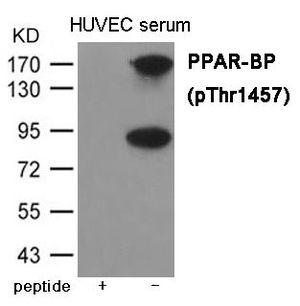
Western blot analysis of extracts from HUVEC cells treated with serum using PPAR-BP (Phospho-Thr1457) Antibody. The lane on the left is treated with the antigen-specific peptide.| Product Name | MED1 (phospho Thr1457) antibody |
|---|---|
| Antibody Type | Primary Antibodies |
| Product description | Rabbit Polyclonal antibody to MED1 (phospho Thr1457)The activation of gene transcription is a multistep process that is triggered by factors that recognize transcriptional enhancer sites in DNA. These factors work with co-activators to direct transcriptional initiation by the RNA polymerase II apparatus. The protein encoded by this gene is a subunit of the CRSP (cofactor required for SP1 activation) complex, which, along with TFIID, is required for efficient activation by SP1. This protein is also a component of other multisubunit complexes e.g. thyroid hormone receptor-(TR-) associated proteins which interact with TR and facilitate TR function on DNA templates in conjunction with initiation factors and cofactors. It also regulates p53-dependent apoptosis and it is essential for adipogenesis. This protein is known to have the ability to self-oligomerize. [provided by RefSeq, Jul 2008] |
| Immunogen | Peptide sequence around phosphorylation site of Threonine 1457 (A-Y-T(p)-P-Q) derived from Human PPAR-BP. |
| Modification | p-Thr1457 |
| Clonality | Polyclonal |
|---|---|
| Isotype | IgG |
| Host Species | Rabbit |
| Tested Applications | WB |
| WB: 1:500 - 1:1000: |
|
| Species Reactivity | HumanMouse |
| Concentration | 1mg/ml (Please refer to the vial label for the specific concentration) |
| Purification | Affinity purified |
| Gene Synonyms | DRIP205 RB18A CRSP1 CRSP200 PPARBP mediator complex subunit 1 PPARGBP TRIP2 PBP MED1 DRIP230 TRAP220 |
|---|---|
| Target | MED1 (phospho Thr1457) |
| Tissue Specificity | The antibody detects endogenous level of PPAR-BP only when phosphorylated at Threonine 1457. |
Application
Western blot analysis of extracts from HUVEC cells treated with serum using PPAR-BP (Phospho-Thr1457) Antibody. The lane on the left is treated with the antigen-specific peptide.| Application Notes | WB: 1:500 - 1:1000: |
|---|
| Form | Liquid |
|---|---|
| Storage Instructions | Store at -20˚C/1 year |
| Storage Buffer | Supplied at 1.0mg/mL in phosphate buffered saline (without Mg2+ and Ca2+), pH 7.4, 150mM NaCl, 0.02% sodium azide and 50% glycerol. |


