Application
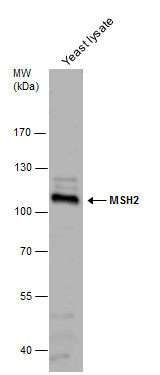
MSH2 antibody detects MSH2 protein by western blot analysis. Yeast extracts (10 μl) was separated by 7.5% SDS-PAGE, and the membrane was blotted with MSH2 antibody at a dilution of 1:1000.| Product Name | MSH2 antibody |
|---|---|
| Antibody Type | Primary Antibodies |
| Product description | Rabbit Polyclonal antibody to MSH2Component of the post-replicative DNA mismatch repair system (MMR). Forms two different heterodimers: MutS alpha (MSH2-MSH6 heterodimer) and MutS beta (MSH2-MSH3 heterodimer), which bind to DNA mismatches thereby initiating DNA repair. MSH2 seems to act as a scaffold for the other MutS homologs that provide substrate-binding and substrate-specificity. When bound, heterodimers bend the DNA helix and shield approximately 20 base pairs. MutS alpha acts mainly to repair base-base and single insertion-deletion mismatches that occur during replication, but can also repair longer insertion-deletion loops (IDLs), although with decreasing efficiency as the size of the extrahelical loop increases. MutS beta acts mainly to repair IDLs from 2 to 13 nucleotides in size, but can also repair base-base and single insertion-deletion mismatches. After mismatch binding, MutS alpha or beta form a ternary complex with a MutL heterodimer, which is thought to be responsible for directing the downstream MMR events, including strand discrimination, excision, and resynthesis. ATP binding and hydrolysis play a pivotal role in mismatch repair functions. Both subunits bind ATP, but with differing affinities, and their ATPase kinetics are also very different. MSH6 binds and hydrolyzes ATP rapidly, whereas MSH2 catalyzes ATP at a substantially slower rate. Binding to a mismatched base pair suppresses MSH6-catalyzed ATP hydrolysis, but not the activity of MSH2. ATP binding to both subunits is necessary to trigger a change in MutS alpha interaction with mismatched DNA, converting MutS alpha into a sliding clamp capable of hydrolysis-independent movement along DNA, and also facilitates formation of ternary complexes containing MutS and MutL proteins and the mismatch. MutS beta also has a role in regulation of heteroduplex formation during mitotic and meiotic recombination. MutS beta binds to DNA flap structures predicted to form during recombination, and is required for 3' non-homologous tail removal (NHTR). MutS beta-binding alters the DNA conformation of its substrate at the ds/ssDNA junction and may facilitate its recognition and/or cleavage by the downstream nucleotide excision repair (NER) RAD1-RAD10 endonuclease. |
| Immunogen | Recombinant protein encompassing a sequence within the C-terminus region of Saccharomyces cerevisiae S288c MSH2. The exact sequence is proprietary. |
| Clonality | Polyclonal |
|---|---|
| Isotype | IgG |
| Host Species | Rabbit |
| Tested Applications | WB |
| *Optimal dilutions/concentrations should be determined by the researcher.
: |
|
| Species Reactivity | Yeast |
| Concentration | 1mg/ml |
| Purification | Affinity purified |
| Gene Synonyms | PMS5 |
|---|---|
| Target | MSH2 |
| Molecular Weight(MW) | 109 kDa (note) |
| Cellular Localization | Nucleus |
Application
MSH2 antibody detects MSH2 protein by western blot analysis. Yeast extracts (10 μl) was separated by 7.5% SDS-PAGE, and the membrane was blotted with MSH2 antibody at a dilution of 1:1000.| Positive Control | Yeast |
|---|---|
| Application Notes | *Optimal dilutions/concentrations should be determined by the researcher.
: |
| Form | Liquid |
|---|---|
| Storage Instructions | Keep as concentrated solution. Aliquot and store at -20ºC or below. Avoid multiple freeze-thaw cycles. |
| Storage Buffer | 1XPBS, 20% Glycerol (pH7). 0.01% Thimerosal was added as a preservative. |


