Application
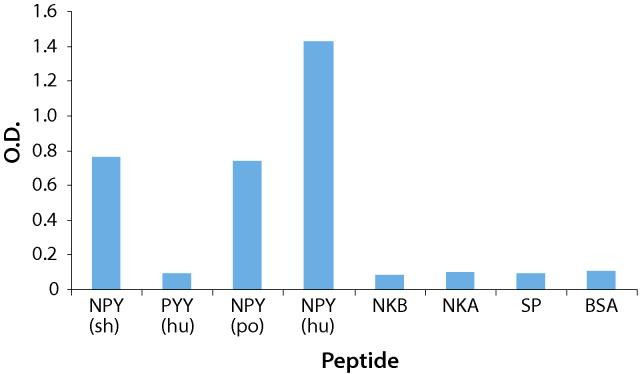
ELISA plates (96 well) were coated with various peptides (Columns 1-7) and BSA (Column 8), (0.5 μg/well), incubated with Anti-Neuropeptide Y (antibody dilution 1:5,000) and developed using Goat Anti-Rabbit IgG-Alkaline Phosphatase (antibody dilution 1:5,000) and a PNPP substrate. Columns (left to right) 1. Neuropeptide Y (NPY) (sheep) 2. Peptide YY (PYY) (human) 3. Neuropeptide Y (NPY) (porcine) 4. Neuropeptide Y (NPY) (human) 5. Neurokinin B (NKB) (human) 6. Neurokinin A (NKA) (human) 7. Substance P (SP) 8. Albumin, bovine (BSA)| Product Name | Neuropeptide Y antibody |
|---|---|
| Antibody Type | Primary Antibodies |
| Product description | Rabbit polyclonal to Neuropeptide YNPY, a 36 amino acid peptide amide isolated from porcine brain, is a major regulatory neuropeptide in the mammalian central and peripheral nervous systems. NPY belongs to the pancreatic polypeptide family of peptides which are characterized by a common tertiary structure. Within this family, an intestinal peptide hormone, Peptide YY (PYY), is most closely related to NPY. In the central nervous system (CNS) NPY is considered to be involved in many central processes including regulation of blood pressure, memory processing, circadian rhythm, and stimulation of food intake. In the peripheral nervous system (PNS), NPY evokes potent vasoconstrictor activity and acts as a neurotransmitter/neuromodulator of sympathetic neurons and adrenal glands. NPY is one of the most abundant peptides found in the CNS. NPY and NPY mRNA are widely distributed in the brain. High levels of NPY are present in the cerebral cortex, amygdaloid nuclei, hippocampal formation, and hypothalamus. In the PNS, NPY is widely distributed in sympathetic neurons that innervate vascular smooth muscle, heart, and urogenital tract. In these neurons NPY is mainly co-localized with norepinephrine and is considered to function as a neurotransmitter to pre-synaptically inhibit nor adrenergic neurotransmission. The biological actions of NPY in the brain and periphery are mediated by at least two different NPY receptors, designated Y1 and Y2 receptor subtypes. Cardiovascular effects and centrally evoked food intake potential are activities predominantly mediated by the Y1 receptors, whereas the Y2 receptors, the major subtype in the CNS, are mainly involved in the pre-synaptic inhibition of neurotransmitter release and facilitation of memory retention. Post- synaptic NPY receptors are apparently of both the Y1 and Y2 type. NPY receptors are coupled to at least two different signal transduction mechanisms, the adenylate cyclase pathway (decrease in cAMP), and the phosphoinositol/IP3 pathway. Antibodies that react specifically with NPY are useful for the study of the mode of action, differential tissue expression, and intracellular and subcellular localization of NPY in the central and peripheral nervous systems. |
| Immunogen | Synthetic Neuropeptide Y (porcine) conjugated to KLH. |
| Clonality | Polyclonal |
|---|---|
| Isotype | IgG |
| Host Species | Rabbit |
| Tested Applications | DotELISAIHC-FRIA |
| Dot: Use at a dilution of 1/10000. This concentration was determined using Neuropeptide Y-BSA (0.03-0.25 ng/dot). IHC-Fr: Use at a dilution of 1/8000. This concentration was determined using frozen sections of rat brain perfusion-fixed with 4% paraformaldehyde. Absorption studies show that specific staining of tissue may be inhibited following preincubation of the antiserum with 10 μM neuropeptide Y (porcine). RIA: Use at a dilution of 1/10000. This concentration was determined using 20 pg/tube of ^125I-labeled neuropeptide Y in a second antibody and polyethylene glycol RIA. The sensitivity of the RIA assay is defined as the 90% intercept of a B/B0 standard curve. In this system the sensitivity has been found to be 20 pg/tube. The affinity constant (Ka) is determined by a Scatchard plot using this RIA system. Ka = Minimum 5.0 x 10^10 L/mole Optimal dilutions/concentrations should be determined by the end user.: |
|
| Species Reactivity | HumanMouseMonkeyPigRatCatRabbitBovine |
| Concentration | 1mg/ml |
| Purification | Affinity purified |
| Gene Synonyms | NPY02 RATNPY RATNPY02 |
|---|---|
| Target | Neuropeptide Y |
| Tissue Specificity | This antibody cross-reacts in dot blot with Peptide YY (PYY) conjugated to BSA. It shows no cross-reactivity in dot blot with Substance P, Neurokinin A, Neurokinin B, Vasoactive Intestinal Peptide (VIP), Calcitonin Generelated Peptide (CGRP) (rat), Calcitonin, and Somatostatin conjugated to BSA, or BSA. |
| Cellular Localization | Secreted |
Application
ELISA plates (96 well) were coated with various peptides (Columns 1-7) and BSA (Column 8), (0.5 μg/well), incubated with Anti-Neuropeptide Y (antibody dilution 1:5,000) and developed using Goat Anti-Rabbit IgG-Alkaline Phosphatase (antibody dilution 1:5,000) and a PNPP substrate. Columns (left to right) 1. Neuropeptide Y (NPY) (sheep) 2. Peptide YY (PYY) (human) 3. Neuropeptide Y (NPY) (porcine) 4. Neuropeptide Y (NPY) (human) 5. Neurokinin B (NKB) (human) 6. Neurokinin A (NKA) (human) 7. Substance P (SP) 8. Albumin, bovine (BSA)| Positive Control | NPY-containing neurons (cell bodies, axons, and dendrites) in frozen sections of rat brain obtained following perfusion fixation with 4% paraformaldehyde.Formalin-fixed, frozen, or Vibratome sections of rat, cat, porcine, bovine, monkey, or human brain |
|---|---|
| Application Notes | Dot: Use at a dilution of 1/10000. This concentration was determined using Neuropeptide Y-BSA (0.03-0.25 ng/dot). IHC-Fr: Use at a dilution of 1/8000. This concentration was determined using frozen sections of rat brain perfusion-fixed with 4% paraformaldehyde. Absorption studies show that specific staining of tissue may be inhibited following preincubation of the antiserum with 10 μM neuropeptide Y (porcine). RIA: Use at a dilution of 1/10000. This concentration was determined using 20 pg/tube of ^125I-labeled neuropeptide Y in a second antibody and polyethylene glycol RIA. The sensitivity of the RIA assay is defined as the 90% intercept of a B/B0 standard curve. In this system the sensitivity has been found to be 20 pg/tube. The affinity constant (Ka) is determined by a Scatchard plot using this RIA system. Ka = Minimum 5.0 x 10^10 L/mole Optimal dilutions/concentrations should be determined by the end user.: |
| Form | Liquid |
|---|---|
| Storage Instructions | Keep as concentrated solution. Store at 4ºC short term. For extended storage aliquot and store at -20ºC or below. Avoid freeze-thaw cycles. |
| Storage Buffer | Whole antiserum containing 0.1% sodium azide |


