Application
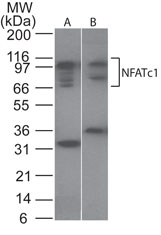
Western blot analysis of human Ramos (A) and mouse RAW (B) lysate using NFATc1 antibody at 1 ug/ml.| Product Name | NFAT2 antibody |
|---|---|
| Antibody Type | Primary Antibodies |
| Product description | Rabbit polyclonal to NFAT2The nuclear factor of activated T-cells (NFAT) transcription complex is required for the expression of a group of proteins that coordinate the immune response. NFATc is the cytosolic component of NFAT and encoded by a separate gene. Expression of NFATc activates the interleukin (IL2) promoter in non-T lymphocytes and is required for IL2 gene expression. It plays a role in the inducible expression of cytokine genes in T cells, especially in the induction of the IL2 or IL4 gene transcription. Also control gene expression in embryonic cardiac cells. Could regulate not only the activation and proliferation but also the differentiation and programmed death of T-lymphocytes as well as lymphoid and non-lymphoid cells. It is a member of the multicomponent NFATC transcription complex that consists of at least two components, a pre-existing cytoplasmic component NFATC2 and an inducible nuclear component NFATC1. Other members such as NFATC4, NFATC3 or members of the activating protein 1 family, MAF, GATA4 and Cbp/p300 can also bind the complex. NFATC proteins bind to DNA as monomers. 6 isoforms of NFATc1 are produced by alternative splicing.It is expressed in thymus, peripheral leukocytes as T-cells and spleen. Isoforms A are preferentially expressed in effector T-cells (thymus and peripheral leukocytes) whereas isoforms B and isoforms C are preferentially expressed in naive T-cells (spleen). Isoforms B are expressed in naive T-cells after first antigen exposure and isoforms A are expressed in effector T-cells after second antigen exposure. Only isoforms A are inducibly expressed in T lymphocytes upon activation of the T-cell receptor (TCR) complex. Induced after co-addition of phorbol 12-myristate 13-acetate (PMA) and ionomycin. Also induced after co-addition of 12 O tetradecanoylphorbol 13 acetate (TPA) and ionomycin. Weakly induced with PMA, ionomycin and cyclosporin A. Rapid nuclear exit of NFATC is thought to be one mechanism by which cells distinguish between sustained and transient calcium signals. The subcellular localization of NFATC play a key role in the gene transcription. |
| Immunogen | Synthetic peptide: NKRKYSLNGRQPPYSPHHS, corresponding to amino acids 263-282 of Human NFAT2. |
| Clonality | Polyclonal |
|---|---|
| Isotype | IgG |
| Host Species | Rabbit |
| Tested Applications | WB |
| Recommended dilutions: WB: Use at a concentration of 1 - 3 μg/ml. Predicted molecular weight varies with isoform. Not yet tested in other applications. Optimal dilutions/concentrations should be determined by the end user.: |
|
| Species Reactivity | HumanMouseRatChimpanzee |
| Concentration | 0.5mg/ml |
| Gene Synonyms | MGC138448 NF-ATC NFAT2 NFATc NF ATC |
|---|---|
| Target | NFAT2 |
| Tissue Specificity | The amino acid sequence used is 100% identical in human NFATc1A, B, C and E isoforms. The NFATc1 antibody may detect multiple isoforms of different sizes depending upon the cell lines. |
| Cellular Localization | Cytoplasmic for the phosphorylated form and nuclear after activation that is controlled by calcineurin-mediated dephosphorylation. |
Application
Western blot analysis of human Ramos (A) and mouse RAW (B) lysate using NFATc1 antibody at 1 ug/ml.| Positive Control | Ramos cell lysate |
|---|---|
| Application Notes | Recommended dilutions: WB: Use at a concentration of 1 - 3 μg/ml. Predicted molecular weight varies with isoform. Not yet tested in other applications. Optimal dilutions/concentrations should be determined by the end user.: |
| Form | Liquid |
|---|---|
| Storage Instructions | Keep as concentrated solution. Store at 4ºC short term. For extended storage aliquot and store at -20ºC or below. Avoid freeze-thaw cycles. |
| Storage Buffer | Preservative: 0.05% Sodium Azide; Constituents: 0.2% Gelatin, PBSMaterial safety datasheet (MSDS) for this product:Sodium Azide MSDS |


