Application
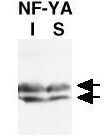
WB analysis of NF-Y expression in chromatin lysates of CHO-7 cells, a clone of CHO-K1 cells adapted for growth in lipoprotein deficient medium, grown in the absence (I) or presence (S) of cholesterol using NFYA antibody.| Product Name | NFYA antibody |
|---|---|
| Antibody Type | Primary Antibodies |
| Product description | Rabbit polyclonal antibody to NFYAThe protein encoded by this gene is one subunit of a trimeric complex, forming a highly conserved transcription factor that binds to CCAAT motifs in the promoter regions in a variety of genes. Subunit A associates with a tight dimer composed of the B and C subunits, resulting in a trimer that binds to DNA with high specificity and affinity. The sequence specific interactions of the complex are made by the A subunit, suggesting a role as the regulatory subunit. In addition, there is evidence of post-transcriptional regulation in this gene product, either by protein degradation or control of translation. Further regulation is represented by alternative splicing in the glutamine-rich activation domain, with clear tissue-specific preferences for the two isoforms. [provided by RefSeq, Jul 2008] |
| Immunogen | NF-Y (A subunit) peptide corresponding to a region near the N-terminus conjugated to KLH |
| Clonality | Polyclonal |
|---|---|
| Isotype | IgG |
| Host Species | Rabbit |
| Tested Applications | ELISAGSAIPWB |
| ELISA: Max Dilution 1/10,000 | |
| Species Reactivity | HumanMouseHamster |
| Concentration | 1mg/ml |
| Purification | Unpurified |
| Gene Synonyms | CBF-B , HAP2 , NF-YA , CBF-A |
|---|---|
| Target | NFY |
| Tissue Specificity | This antibody recognizes both differentially spliced 35kD and 42kD forms of the A subunit of NF-Y. No reactivity against the 25kD B subunit. |
Application
WB analysis of NF-Y expression in chromatin lysates of CHO-7 cells, a clone of CHO-K1 cells adapted for growth in lipoprotein deficient medium, grown in the absence (I) or presence (S) of cholesterol using NFYA antibody.| Application Notes | ELISA: Max Dilution 1/10,000 |
|---|
| Form | Liquid |
|---|---|
| Storage Instructions | Store at +4°C or at -20°C if preferred. This product should be stored undiluted. Storage in frost free freezers is not recommended. Avoid repeated freezing and thawing as this may denature the antibody. Should this product contain a precipitate we recommend microcentrifugation before use. |
| Storage Buffer | Phosphate buffered saline containing 0.01% Sodium Azide |


