Application
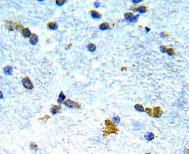
Immunohistochemistry: NMDAR1 phosphospecific Antibody [ - NMDAR1 phosphospecific Antibody [ - paraffin-embedded human brain tissue.| Product Name | NMDAR1 (phospho Ser897) antibody |
|---|---|
| Antibody Type | Primary Antibodies |
| Product description | Rabbit polyclonal antibody to NMDAR1 (phospho-Ser897)NMDA receptor subtype of glutamate-gated ion channels possesses high calcium permeability and voltage-dependent sensitivity to magnesium. Mediated by glycine. Plays a key role in synaptic plasticity, synaptogenesis, excitotoxicity, memory acquisition and learning. It mediates neuronal functions in glutamate neurotransmission. Is involved in the cell surface targeting of NMDA receptors. The ion channels activated by glutamate are divided into two classes. Those that are sensitive to N-methyl-D-aspartate (NMDA) are designated NMDA receptors (NMDAR) while those activated by kainate and a-amino-3-hydroxy-5-methyl-4-isoxalone propionic acid (AMPA) are known as kainate/AMPA receptors (K/AMPAR). NMDA receptors are among the most studied receptors in neuroscience because they are involved in neuronal cell development and plasticity, a cellular correlate for learning. NMDA receptors are also implicated in several disorders of the central nervous sytem including epilepsy and ischemic neuronal cell death. NMDA receptors also appear to be a target for ethanol at physiological concentrations and therefore may play a significant role in alcoholism |
| Modification | p-Ser897 |
| Clonality | Polyclonal |
|---|---|
| Isotype | IgG |
| Host Species | Rabbit |
| Tested Applications | IHCIHC-P |
| We recommend the following starting dilutions: immunohistochemistry 1:50-1:200. Optimal concentration should be determined experimentally by the end user.: |
|
| Species Reactivity | HumanMouseRat |
| Concentration | 1mg/ml |
| Purification | Affinity purified |
| Gene Synonyms | Nmdar1 2902 24408 GRIN1 NMDA1 14810 NR1 glutamate NMDAR1 (phospho S897) NMDAR1 (phospho Ser897) NMDAR1 (pS897) NMDAR1 (pSer897) NMDAR1 phospho S897 NMDAR1 phospho Ser897 Phospho NMDAR1 (S897) Phospho NMDAR1 (Ser897) Phospho NMDAR1 (pS897) |
|---|---|
| Target | NMDAR1 (phospho-Ser897) |
| Tissue Specificity | p-NMDAR1 (S897) detects endogenous levels of p-NMDAR1 protein. |
Application
Immunohistochemistry: NMDAR1 phosphospecific Antibody [ - NMDAR1 phosphospecific Antibody [ - paraffin-embedded human brain tissue.| Application Notes | We recommend the following starting dilutions: immunohistochemistry 1:50-1:200. Optimal concentration should be determined experimentally by the end user.: |
|---|
| Form | Liquid |
|---|---|
| Storage Instructions | Store at 4C short term. Aliquot and store at -20C long term. Avoid freeze-thaw cycles. |
| Storage Buffer | Phosphate buffered saline (PBS) with 15 mM sodium azide, approx. pH 7.2. |


