Application
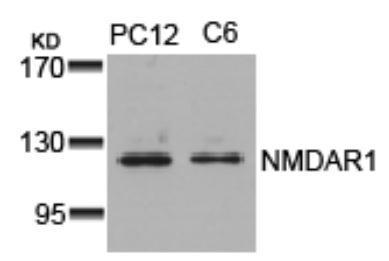
Western blot analysis of extracts from PC12 and C6 cells using NMDAR1 Antibody| Product Name | NMDAR1 antibody |
|---|---|
| Antibody Type | Primary Antibodies |
| Product description | Rabbit Polyclonal antibody to NMDAR1NMDA receptors are members of the ionotropic class of glutamate receptors, which also includes Kainate and AMPA receptors. NMDA receptors consist of NR1 subunits combined with one or more NR2 (A-D) or NR3 (A-B) subunits. The ligand-gated channel is permeable to cations including Ca2+, and at resting membrane potentials NMDA receptors are inactive due to a voltage-dependent blockade of the channel pore by Mg2+. NMDA receptor activation, which requires binding of glutamate and glycine, leads to an influx of Ca2+ into the postsynaptic region where it activates several signaling cascades, including pathways leading to the induction of long-term potentiation (LTP) and depression (LTD). NMDA receptors have a critical role in excitatory synaptic transmission and plasticity in the CNS. They govern a range of physiological conditions including neurological disorders caused by excitotoxic neuronal injury, psychiatric disorders and neuropathic pain syndromes. |
| Immunogen | Peptide sequence around aa.894~898 (R-R-S-S-K) derived from Human NMDAR1. |
| Clonality | Polyclonal |
|---|---|
| Isotype | IgG |
| Host Species | Rabbit |
| Tested Applications | WB |
| Suggested starting dilutions are as follows. WB: 1:500~1:1000. Not yet tested in other applications. Optimal working dilutions should be determined experimentally by the end user.: |
|
| Species Reactivity | Rat |
| Predicted Reactivity | Human, MouseHuman,Mouse |
| Concentration | 1mg/ml (Please refer to the vial label for the specific concentration) |
| Purification | Affinity purified |
| Gene Synonyms | NMDA1 NMDAR1 NR1 GRIN1 NMD-R1 glutamate [NMDA] receptor subunit zeta 1 N-methyl-D-aspartate receptor channel subunit zeta-1 N-methyl-D-aspartate receptor subunit NR1 glutamate [NMDA] receptor subunit zeta-1 glutamate receptor ionotropic N-methy |
|---|---|
| Target | NMDAR1 |
| Molecular Weight(MW) | 120 (note) |
Application
Western blot analysis of extracts from PC12 and C6 cells using NMDAR1 Antibody| Application Notes | Suggested starting dilutions are as follows. WB: 1:500~1:1000. Not yet tested in other applications. Optimal working dilutions should be determined experimentally by the end user.: |
|---|
| Form | Liquid |
|---|---|
| Storage Instructions | Keep as concentrated solution. Aliquot and store at -20ºC or below. Avoid multiple freeze-thaw cycles. |
| Storage Buffer | saline (without Mg2+ and Ca2+), pH 7.4, 150mM NaCl, 0.02% sodium azide and 50% glycerol. |


