Application
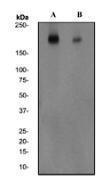
A. Western blot analysis on mouse brain lysates using anti-Phospho-NMDAR2B (pS1303) RabMAb (cat. #) 1:5000 dilution. Cells were either (A) untreated (B) treated with AP| Product Name | NMDAR2B (phospho Ser1303) antibody |
|---|---|
| Antibody Type | Primary Antibodies |
| Product description | Rabbit monoclonal antibody [EP1858Y] to NMDAR2B (phospho Ser1303)The NMDA (N-methyl D-aspartate) receptors in the brain play a critical role in synaptic plasticity, synaptogenesis and excitotoxicity. NMDA R1 and combination of one or more NMDAR2 subunits forms NMDA receptor glutamate-gated ion channels. In this hetromer complex, NMDA R1 binds to co-agonist glycine and NMDA R2 binds to neurotransmitter glutamate . Several studies have suggested that protein phosphorylation of NMDA receptors may affect channel function, and additionally regulate these receptors’ synaptic trafficking and surface expression. Once activated thru phospholyation, these channels allow movement of Ca2+ and Na+ into the cell and K+ out of the cell. Serine 1303 on NMDAR2B has been identified as a major phospholyation site for CaM kinase II and PKC, regulating kinase-mediated NMNDAR2B/R1 current . NMDAR has been linked to various neurodegenerative disorders such as schizophrenia, epilepsy, and Alzheimer's disease . |
| Immunogen | A phospho specific peptide corresponding to residues surrounding serine 1303 of human NMDAR2B was used as an immunogen. |
| Modification | p-Ser1303 |
| Clonality | Monoclonal |
|---|---|
| Isotype | IgG |
| Clone Number | EP1858Y |
| Host Species | Rabbit |
| Tested Applications | ICC/IFWB |
| For WB: Use at a dilution of 1:1000 - 5000: |
|
| Species Reactivity | HumanMouseRat |
| Concentration | 1mg/ml |
| Gene Synonyms | MGC142180 NR2B NMDAR2B GRIN2B MGC142178 hNR3 NMDAR2B (phospho S1303) NMDAR2B (phospho Ser1303) NMDAR2B (pS1303) NMDAR2B (pSer1303) NMDAR2B phospho S1303 NMDAR2B phospho Ser1303 Phospho NMDAR2B (S1303) Phospho NMDAR2B (Ser1303) Phospho NMDAR2B |
|---|---|
| Target | NMDAR2B Phospho (pS1303) |
| Molecular Weight(MW) | 180 (note) |
| Tissue Specificity | This antibody detects NMDAR2B phosphorylated at serine 1303. |
Application
A. Western blot analysis on mouse brain lysates using anti-Phospho-NMDAR2B (pS1303) RabMAb (cat. #) 1:5000 dilution. Cells were either (A) untreated (B) treated with AP| Application Notes | For WB: Use at a dilution of 1:1000 - 5000: |
|---|
| Form | Liquid |
|---|---|
| Storage Instructions | Store at -20 °C. Stable for 12 months from date of receipt. |
| Storage Buffer | 50 mM Tris-Glycine (pH 7.4), 0.15 M NaCl, 40% Glycerol, 0.01% sodium azide and 0.05% BSA. |


