Application
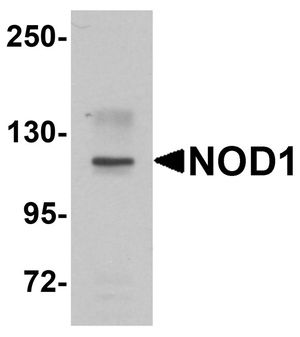
Western blot analysis of NOD1 in EL4 cell lysate with NOD1 antibody at 1 ug/mL.| Product Name | NOD1 antibody |
|---|---|
| Antibody Type | Primary Antibodies |
| Product description | Rabbit Polyclonal antibody to NOD1This gene encodes a member of the NOD (nucleotide-binding oligomerization domain) family. This member is a cytosolic protein. It contains an N-terminal caspase recruitment domain (CARD), a centrally located nucleotide-binding domain (NBD), and 10 tandem leucine-rich repeats (LRRs) in its C terminus. The CARD is involved in apoptotic signaling, LRRs participate in protein-protein interactions, and mutations in the NBD may affect the process of oligomerization and subsequent function of the LRR domain. This protein is an intracellular pattern-recognition receptor (PRR) that initiates inflammation in response to a subset of bacteria through the detection of bacterial diaminopimelic acid. Multiple alternatively spliced transcript variants differring in the 5' UTR have been described, but the full-length nature of these variants has not been determined. [provided by RefSeq, Oct 2009] |
| Immunogen | NOD1 antibody was raised against a 16 amino acid synthetic peptide near the carboxy end of human NOD1. |
| Clonality | Polyclonal |
|---|---|
| Isotype | IgG |
| Host Species | Rabbit |
| Tested Applications | ELISAWB |
| WB: 1 ug/ml | |
| Species Reactivity | Mouse |
| Concentration | 1mg/ml (Please refer to the vial label for the specific concentration) |
| Purification | Affinity purified |
| Gene Synonyms | NLRC1 , CARD4 , nucleotide-binding oligomerization domain containing 1 , CLR7.1 |
|---|---|
| Target | NOD1 |
Application
Western blot analysis of NOD1 in EL4 cell lysate with NOD1 antibody at 1 ug/mL.| Application Notes | WB: 1 ug/ml |
|---|
| Form | Liquid |
|---|---|
| Storage Instructions | Be stored at 4oC for three months and -20oC, stable for up to one year. As with all antibodies care should be taken to avoid repeated freeze thaw cycles. Antibodies should not be exposed to prolonged high temperatures. |
| Storage Buffer | PBS containing 0.02% sodium azide. |


