Application
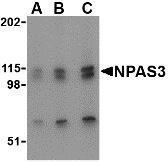
Western blot analysis of NPAS3 in SK-N-SH cell lysate with NPAS3 antibody at (A) 0.5, (B) 1 and (C) 2 ug/ml.Application
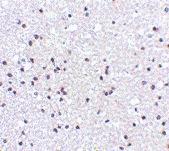
Immunohistochemistry of NPAS3 in human brain tissue with NPAS3 antibody at 5 ug/ml.| Product Name | NPAS3 antibody |
|---|---|
| Antibody Type | Primary Antibodies |
| Product description | Rabbit polyclonal antibody to NPAS3Neuronal PAS domain protein 3 (NPAS3) is a brain-enriched basic helix-loop-helix PAS domain transcription factor and is broadly expressed in the developing neuroepithelium and has recently found to be disrupted by genetic translocation in a family affected with schizophrenia. It was recently shown to be involved in the regulation of FGF signaling in the dentate gyrus by controlling the expression of the FGF receptor subtype 1 and in turn neurogenesis emanating from this region. NPAS3-null mice were growth-retarded and displayed brain defects that included reduced size of the anterior hippocampus, hypoplasia of the corpus callosum, and enlargement of the ventricles, as well as several behavioral abnormalities. Furthermore, these NPAS3-null mice also exhibited disruptions in several neurosignaling pathways involving glutamate, dopamine, and serotonin. These results demonstrate the essential role played by NPAS3 during structural and functional brain development. At least three isoforms of NPAS3 are known to exist. |
| Clonality | Polyclonal |
|---|---|
| Host Species | Rabbit |
| Tested Applications | ELISAIHC-PWB |
| IHC-P:1:50~1:200 WB:1:500~1:2000 Notes:Optimal dilutions/concentrations should be determined by the researcher. |
|
| Species Reactivity | HumanMouseRat |
| Concentration | 1mg/ml |
| Purification | Affinity purified |
| Gene Synonyms | Neuronal PAS domaincontaining protein 3 member of Pas protein 6 member of Pas protein6 NPAS3 MOP6 Neuronal PAS domain-containing protein 3 Neuronal PAS domaincontaining protein3 |
|---|---|
| Target | NPAS3 |
| Tissue Specificity | This antibody is specific for NPAS3 N-Terminus |
Application
Western blot analysis of NPAS3 in SK-N-SH cell lysate with NPAS3 antibody at (A) 0.5, (B) 1 and (C) 2 ug/ml.
Application
Immunohistochemistry of NPAS3 in human brain tissue with NPAS3 antibody at 5 ug/ml.| Positive Control | Blocking Peptide: Cat.No. GTX85445-PEP - NPAS3 Peptide Lysates: Cat. No. GTX23956 - SK-N-SH Cell LysateCat. No. GTX27918 - Human Brain Tissue Lysate |
|---|---|
| Application Notes | IHC-P:1:50~1:200 WB:1:500~1:2000 Notes:Optimal dilutions/concentrations should be determined by the researcher. |
| Form | Liquid |
|---|---|
| Storage Instructions | Keep as concentrated solution. Aliquot and store at -20ºC or below. Avoid multiple freeze-thaw cycles. |
| Storage Buffer | PBS containing 0.02% sodium azide |


