Application
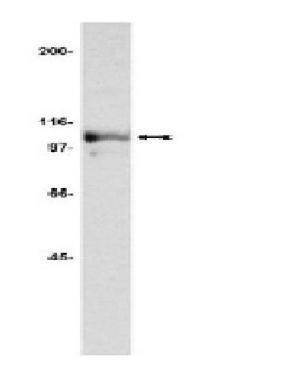
Western Blot analysis using Nucleolin [4i51] antibody on a Hela nuclear extract| Product Name | Nucleolin antibody |
|---|---|
| Antibody Type | Primary Antibodies |
| Product description | Mouse monoclonal [4i51] to NucleolinNucleolin, which is identical to human DNA helicase IV, is a major nucleolar phosphoprotein which is associated with preribosomal RNA and is implicated in the early stage of preribosomal RNP assembly and processing. This 100 kDa protein has three major domains: a N-terminal domain comprised of long acidic stretches interspersed with basic repeats, similar to the structure of a high mobility group-type protein (this domain is responsible for the ablility of nucleolin to modulate chromatin condensation), a central domain that contains four RNA binding elements, a C-terminal domain approximately 85 amino acids long that is rich in glycine, arginine, and phenylalanine residues. Nucleolin fluctuates in parallel to DNA synthesis; intact 100 kDa protein is the major species in actively dividing cells, whereas the degraded forms are relativley abundant in nondividing cells. Nucleolin can unwind RNA-RNA duplexes, as well as DNA-DNA and DNA-RNA duplexes. Nucleolin also interacts directly with DNA topoisomerase I. It is located mainly in dense fibrillar regions of the nucleolus. Nucleolin is the major nucleolar protein of growing eukaryotic cells. It is found associated with intranucleolar chromatin and preribosomal particles. It induces chromatin decondensation by binding to histone H1. It is thought to play a role in pre-rRNA transcription and ribosome assembly. It interacts with APTX and contains 4 RNA recognition motif (RRM) domains. |
| Immunogen | Nuclear matrix extract from Human MDCK cells. |
| Clonality | Monoclonal |
|---|---|
| Isotype | IgG1 |
| Clone Number | 4i51 |
| Host Species | Mouse |
| Tested Applications | ELISAICC/IFIPWB |
| ELISA: Use at an assay dependent dilution. ICC: Use at a dilution of 1/10 - 1/100. Shows positive immunostaining for nucleolin in HeLa cells fixed with 4% paraformaldehyde and permeabilized with 0.25% Triton X 100IP: Use at an assay dependent dilution. WB: Use at a dilution of 1/1000 - 1/5000. detects nucleolin in HeLa nuclear extract. HeLa nuclear extract was resolved by electrophoresis, transferred to nitrocellulose and probed with anti nucleolin (1:5000 dilution). Proteins were visualized using a goat anti mouse secondary antibody conjugated to HRP and a chemiluminescence detection system. Predicted molecular weight: 85 kDa. Optimal dilutions/concentrations should be determined by the end user.: |
|
| Species Reactivity | HumanDogMonkey |
| Concentration | 1mg/ml |
| Gene Synonyms | C23 FLJ45706 FLJ59041 |
|---|---|
| Target | Nucleolin |
| Tissue Specificity | Recognizes nucleolin, Mr 100kDa and an additional protein, Mr 95kDa. |
| Cellular Localization | Nuclear, located mainly in dense fibrillar regions of the nucleolus. |
Application
Western Blot analysis using Nucleolin [4i51] antibody on a Hela nuclear extract| Positive Control | HeLa nuclear extract/ HeLa cells |
|---|---|
| Application Notes | ELISA: Use at an assay dependent dilution. ICC: Use at a dilution of 1/10 - 1/100. Shows positive immunostaining for nucleolin in HeLa cells fixed with 4% paraformaldehyde and permeabilized with 0.25% Triton X 100IP: Use at an assay dependent dilution. WB: Use at a dilution of 1/1000 - 1/5000. detects nucleolin in HeLa nuclear extract. HeLa nuclear extract was resolved by electrophoresis, transferred to nitrocellulose and probed with anti nucleolin (1:5000 dilution). Proteins were visualized using a goat anti mouse secondary antibody conjugated to HRP and a chemiluminescence detection system. Predicted molecular weight: 85 kDa. Optimal dilutions/concentrations should be determined by the end user.: |
| Form | Liquid |
|---|---|
| Storage Instructions | May be stored at 4°C for short-term only. Aliquot to avoid repeated freezing and thawing. Store at -20°C. Aliquots are stable for at least 12 months. For maximum recovery of product, centrifuge the original vial after thawing and prior to removing the cap |
| Storage Buffer | Culture supernatant containing 0.05% sodium azide prior to the addition of glycerol to 30%. |


