Application
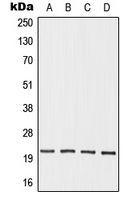
Western blot analysis of OAZ3 expression in HEK293T (A); Jurkat (B); mouse testis (C); rat testis (D) whole cell lysates.| Product Name | OAZ3 antibody |
|---|---|
| Antibody Type | Primary Antibodies |
| Product description | Rabbit Polyclonal antibody to OAZ3Ornithine decarboxylase catalyzes the conversion of ornithine to putrescine in the first and apparently rate-limiting step in polyamine biosynthesis. The ornithine decarboxylase antizymes play a role in the regulation of polyamine synthesis by binding to and inhibiting ornithine decarboxylase. Antizyme expression is auto-regulated by polyamine-enhanced translational frameshifting. In contrast to antizymes 1 and 2, which are widely expressed throughout the body, the expression of this gene product (antizyme 3) is restricted to testis germ cells, and thus it is a possible candidate for heritable forms of human male infertility. Alternatively spliced transcript variants encoding different isoforms have been found for this gene. [provided by RefSeq, Sep 2008] |
| Immunogen | KLH-conjugated synthetic peptide encompassing a sequence within the center region of human OAZ3. The exact sequence is proprietary. |
| Clonality | Polyclonal |
|---|---|
| Isotype | IgG |
| Host Species | Rabbit |
| Tested Applications | WB |
| WB:1:500~1:2000 Notes:Optimal dilutions/concentrations should be determined by the researcher. |
|
| Species Reactivity | HumanMouseRat |
| Concentration | 1mg/ml |
| Purification | Affinity purified |
| Gene Synonyms | ornithine decarboxylase antizyme 3 |
|---|---|
| Target | OAZ3 |
| Tissue Specificity | Recognizes endogenous levels of OAZ3 protein. |
Application
Western blot analysis of OAZ3 expression in HEK293T (A); Jurkat (B); mouse testis (C); rat testis (D) whole cell lysates.| Application Notes | WB:1:500~1:2000 Notes:Optimal dilutions/concentrations should be determined by the researcher. |
|---|
| Form | Liquid |
|---|---|
| Storage Instructions | Shipped at 4 C. Upon delivery aliquot and store at -20 C for one year. Avoid freeze/thaw cycles. |
| Storage Buffer | Liquid in 0.42% Potassium phosphate; 0.87% Sodium chloride; pH 7.3; 30% glycerol; and 0.01% sodium azide. |


