Application
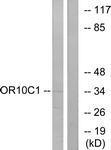
Western blot analysis of extracts from LOVO cells, using OR10C1 Antibody. The lane on the right is treated with the synthesized peptide.| Product Name | OR10C1 antibody |
|---|---|
| Antibody Type | Primary Antibodies |
| Product description | Rabbit polyclonal antibody to OR10C1Olfactory receptors interact with odorant molecules in the nose, to initiate a neuronal response that triggers the perception of a smell. The olfactory receptor proteins are members of a large family of G-protein-coupled receptors (GPCR) arising from single coding-exon genes. Olfactory receptors share a 7-transmembrane domain structure with many neurotransmitter and hormone receptors and are responsible for the recognition and G protein-mediated transduction of odorant signals. The olfactory receptor gene family is the largest in the genome. The nomenclature assigned to the olfactory receptor genes and proteins for this organism is independent of other organisms. [provided by RefSeq] |
| Immunogen | The antiserum was produced against synthesized peptide derived from human OR10C1. |
| Clonality | Polyclonal |
|---|---|
| Host Species | Rabbit |
| Tested Applications | ELISAWB |
| ELISA: 1:40000Optimal dilutions should be determined experimentally by the end user.: |
|
| Species Reactivity | Human |
| Concentration | 1mg/ml |
| Purification | Affinity purified |
| Gene Synonyms | XXbac-BPG13B8.1-001 family 10 family10 OR10C1 member 1 member1 XXbacBPG13B8.1001 : OR10C1 subfamily C Olfactory receptor XXbac BPG13B8.1 001 |
|---|---|
| Target | OR10C1 |
| Molecular Weight(MW) | 34 kDa (note) |
| Tissue Specificity | OR10C1 Antibody detects endogenous levels of total OR10C1 protein. |
Application
Western blot analysis of extracts from LOVO cells, using OR10C1 Antibody. The lane on the right is treated with the synthesized peptide.| Application Notes | ELISA: 1:40000Optimal dilutions should be determined experimentally by the end user.: |
|---|
| Form | Liquid |
|---|---|
| Storage Instructions | Store at -20 degrees Celcius. Product is stable for at least 1 year. |
| Storage Buffer | Phosphate buffered saline (without Mg2+ and Ca2+), pH 7.4, 150mM NaCl, 0.02% sodium azide and 50% glycerol. |


