Application
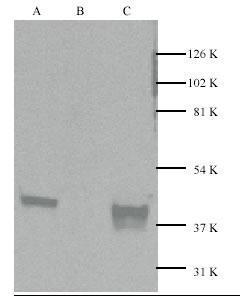
staining p38 in HeLa whole cell lysate (lane A), HL-60 whole cell lysate (lane B) and NIH / 3T3 whole cell lysate (lane C).| Product Name | p38 MAPK antibody |
|---|---|
| Antibody Type | Primary Antibodies |
| Product description | Rabbit polyclonal antibody to p38 MAPKMAP kinases consist of several subgroups, including the ERK, JNK, and p38 kinases. The members are regulated by many different extracellular cues ranging from cytokines, growth factors, and neuropeptides (1). These stimuli activate cell surface receptors to stresses such as cold, heat, osmolarity changes and irradiation. The pathways regulated by the MAPKs control a broad array of cellular responses ranging from survival, cell proliferation, and apoptosis (1,2). The MAPKs family is also characterized by their requirement for dual phosphorylation at a conserved threonine and tyrosine residue for enzymatic activation and both must be phosphorylated for full enzymatic activation (3). The closely related ERK1 (44 kDa) and ERK2 (42 kDa) kinases are characterized by their requirement for dual phosphorylation at a conserved T-E-Y motif (4,5). While JNK1 is activated by dual phosphorylation at a T-P-Y motif and p38 is also activated by dual phosphorylation at a T-G-Y motif (6,7). |
| Immunogen | Synthetic peptide (Mouse) identical to the corresponding human sequence. |
| Clonality | Polyclonal |
|---|---|
| Isotype | IgG |
| Host Species | Rabbit |
| Tested Applications | IHCIPWB |
| For IHC: Use at an assay dependent dilution. For IP: Use at an assay dependent dilution. For WB: Use at a dilution of 1:200. Optimal dilutions/concentrations should be determined by the researcher.: |
|
| Species Reactivity | HumanMouseRat |
| Concentration | 0.2mg/ml |
| Gene Synonyms | CSAID Binding Protein 1 CSBP 1 Cytokine Supressive Anti-Inflamatory Drug Binding Protein 1 MAPK 14 Mitogen Activated Protein Kinase 14 SAPK 2A Stress Activated Protein Kinase 2A |
|---|---|
| Target | p38 MAPK |
Application
staining p38 in HeLa whole cell lysate (lane A), HL-60 whole cell lysate (lane B) and NIH / 3T3 whole cell lysate (lane C).| Positive Control | HeLa, HL-60, and NIH/3T3 |
|---|---|
| Application Notes | For IHC: Use at an assay dependent dilution. For IP: Use at an assay dependent dilution. For WB: Use at a dilution of 1:200. Optimal dilutions/concentrations should be determined by the researcher.: |
| Form | Liquid |
|---|---|
| Storage Instructions | Keep as concentrated solution, aliquot and store at 4°C. Do not freeze. |
| Storage Buffer | Phosphate-buffered saline containing 0.1% sodium azide and 0.2% gelatin |


