Application
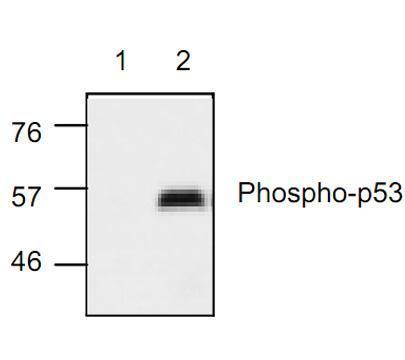
Western blot analysis of extract from untreated (Lane 1) and UV treated (lane 2) HeLa cells using| Product Name | p53 (phospho Ser15) antibody |
|---|---|
| Antibody Type | Primary Antibodies |
| Product description | Rabbit polyclonal to p53 ( phospho S15 )The p53 tumor suppressor protein plays a major role in cellular response to DNA damage and other genomic aberrations. The activation of p53 can lead to either cell cycle arrest and DNA repair or apoptosis. p53 is phosphorylated at multiple sites in vivo and by several different protein kinases in vitro. p53 can apparently be phosphorylated by ATM, ATR, and DNA-PK at Ser15; the phosphorylation impairs the ability of MDM2 to bind p53, promoting both the accumulation and functional activation of p53 in response to DNA damage. |
| Immunogen | Synthetic phospho-peptide surrounding amino acid Ser 15 of human p53. |
| Modification | p-Ser15 |
| Clonality | Polyclonal |
|---|---|
| Isotype | IgG |
| Host Species | Rabbit |
| Tested Applications | IHCIPWB |
| For IHC: Use at a concentration of 20 µg/ml. For IP: Use at a concentration of 5-10 µg/ml. For WB: Use at a dilution of 0.5-4 µg/ml. Optimal dilutions/concentrations should be determined by the researcher.: |
|
| Species Reactivity | HumanMouseRat |
| Concentration | 0.5mg/ml |
| Gene Synonyms | p53 (phospho S15) p53 (phospho Ser15) p53 (pS15) p53 (pSer15) p53 phospho S15 p53 phospho Ser15 Phospho p53 (S15) Phospho p53 (Ser15) Phospho p53 (pS15) Phospho p53 (pSer15) |
|---|---|
| Target | TP53 |
| Tissue Specificity | The phospho-p53 (Ser15) antibody detects ~53 kDa phosphorylated p53 at Ser15. It does not react with non-phosphorylated p53 or p53 phosphorylated at other sites. |
| Cellular Localization | Cytoplasmic and Nuclear |
Application
Western blot analysis of extract from untreated (Lane 1) and UV treated (lane 2) HeLa cells using| Application Notes | For IHC: Use at a concentration of 20 µg/ml. For IP: Use at a concentration of 5-10 µg/ml. For WB: Use at a dilution of 0.5-4 µg/ml. Optimal dilutions/concentrations should be determined by the researcher.: |
|---|
| Form | Liquid |
|---|---|
| Storage Instructions | Keep as concentrated solution. Aliquot and store at -20°C or below. Avoid freeze-thaw cycles. |
| Storage Buffer | Phosphate-buffered saline, pH 7.2, containing 30% glycerol, 0.5% BSA, and 0.01% thimerosal |


