Application
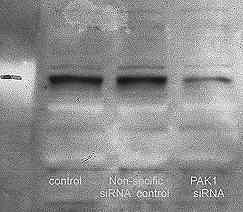
Western blot probing with PAK1 antibody . The major band is at 65 kDa and weaker bands can be detected at 90 and 100 kDa. This picture was kindly submitted by Sue Thomas as part of her review.| Product Name | PAK1 + PAK2 + PAK3 (phospho Thr423) antibody |
|---|---|
| Antibody Type | Primary Antibodies |
| Product description | Rabbit Polyclonal antibody to PAK1 + PAK2 + PAK3 (phospho Thr423)The p21-activated kinases (PAKs) are a family of multifunctional serine/threonine kinases involved in a variety of cell functions including stress response, apoptosis and regulation of cell motility and tumor metastasis. Mammalian PAKs are called 1, 2, 3 or a, g, b respectively. PAKs are part of a large family of kinases where the catalytic domain of the kinase is related to Ste20 kinase of S. cerevisiae. Pak activity is regulated by specific binding of GTP-bound Rac and cdc42 GTPases and also by sphingosine and related lipids. PAK1 activation is induced by a variety of growth factors and G-protein-coupled receptors, Fc receptors, and integrins. This antibody is specific for the phosphorylated form of PAK 1+2+3. The selected peptide sequence used to generate the polyclonal antibody is common to all human PAKs. |
| Immunogen | Synthetic peptide: EQSKRST p MVGTPY conjugated to KLH, corresponding to amino acids 413-433 of Human PAK 1, 408-428 of human PAK 2 and 411-431 of human PAK 3. |
| Modification | p-Thr423 |
| Clonality | Polyclonal |
|---|---|
| Isotype | IgG |
| Host Species | Rabbit |
| Tested Applications | ELISAWB |
| *Optimal dilutions/concentrations should be determined by the researcher.
: |
|
| Species Reactivity | Human |
| Concentration | 1mg/ml |
| Purification | Affinity purified |
| Target | PAK1 + PAK2 + PAK3 |
|---|
Application
Western blot probing with PAK1 antibody . The major band is at 65 kDa and weaker bands can be detected at 90 and 100 kDa. This picture was kindly submitted by Sue Thomas as part of her review.| Application Notes | *Optimal dilutions/concentrations should be determined by the researcher.
: |
|---|
| Form | Liquid |
|---|---|
| Storage Instructions | Store vial at -20° C prior to opening. Aliquot contents and freeze at -20° C or below for extended storage. Avoid cycles of freezing and thawing. |
| Storage Buffer | 0.02 M Potassium Phosphate, 0.15 M Sodium Chloride, pH 7.2 and 0.01% (w/v) Sodium Azide |


