Application
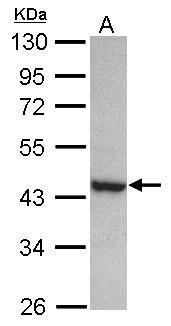
Sample (30 ug of whole cell lysate) A: A431 10% SDS PAGE diluted at 1:1000| Product Name | PAK1 interacting protein 1 antibody |
|---|---|
| Antibody Type | Primary Antibodies |
| Product description | Rabbit polyclonal antibody to PAK1 interacting protein 1 (PAK1 interacting protein 1)Negatively regulates the PAK1 kinase. PAK1 is a member of the PAK kinase family, which have been shown to play a positive role in the regulation of signaling pathways involving MAPK8 and RELA. PAK1 exists as an inactive homodimer, which is activated by binding of small GTPases such as CDC42 to an N-terminal regulatory domain. PAK1IP1 also binds to the N-terminus of PAK1, and inhibits the specific activation of PAK1 by CDC42. |
| Immunogen | Recombinant protein encompassing a sequence within the center region of human PAK1 interacting protein 1. The exact sequence is proprietary. |
| Clonality | Polyclonal |
|---|---|
| Isotype | IgG |
| Host Species | Rabbit |
| Tested Applications | WB |
| *Optimal dilutions/concentrations should be determined by the researcher.
: |
|
| Species Reactivity | Human |
| Predicted Reactivity | Mouse, Rat, Chicken, Rhesus Monkey, BovineMouse (81%), Rat (89%), Chicken (80%), Rhesus Monkey (100%), Bovine (87%) |
| Concentration | 1mg/ml (Please refer to the vial label for the specific concentration) |
| Purification | Affinity purified |
| Gene Synonyms | FLJ20624 antibody MAK11 antibody PIP1 antibody RP11-421M1.5 antibody WDR84 antibody bA421M1.5 antibody hPIP1 antibody PAK1IP1 antibody PAK/PLC-interacting protein 1 antibody p21-activated protein kinase-interacting protein 1 antibody PAK1-interac |
|---|---|
| Target | PAK1 interacting protein 1 |
| Molecular Weight(MW) | 44 kDa (note) (2) |
| Cellular Localization | Nucleus , nucleolus |
Application
Sample (30 ug of whole cell lysate) A: A431 10% SDS PAGE diluted at 1:1000| Positive Control | 293T , A431 , Jurkat , Raji |
|---|---|
| Application Notes | *Optimal dilutions/concentrations should be determined by the researcher.
: |
| Form | Liquid |
|---|---|
| Storage Instructions | Keep as concentrated solution. Aliquot and store at -20ºC or below. Avoid multiple freeze-thaw cycles. |
| Storage Buffer | 0.1M Tris, 0.1M Glycine, 20% Glycerol (pH7). 0.01% Thimerosal was added as a preservative. |


