Application
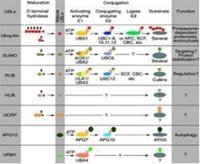
Most modifiers mature by proteolytic processing from inactive precursors (a; amino acid). Arrowheads point to the cleavage sites. Ubiquitin is expressed either as polyubiquitin or as a fusion with ribosomal proteins. Conjugation requires activating (E1) and conjugating (E2) enzymes that form thiolesters (S) with the modifiers. Modification of cullins by RUB involves SCF(SKP1/cullin-1/F-box protein) /CBC(cullin-2/elongin B/elonginC) -like E3 enzymes that are also involved in ubiquitination. In contrast to ubiquitin, the UBLs do not seem to form multi-UBL chains. UCRP(ISG15) resembles two ubiquitin moieties linked head-to-tail. Whether HUB1 functions as a modifier is currently unclear. APG12 and URM1 are distinct from the other modifiers because they are unrelated in sequence to ubiquitin. Data contributed by S.Jentsch.| Product Name | PARC Antibody |
|---|---|
| Antibody Type | Primary Antibodies |
| Product description | Rabbit Polyclonal antibody to PARCCullins assemble a potentially large number of ubiquitin ligases by binding to the RING protein ROC1 to catalyse polyubiquitination, as well as binding to various specificity factors to recruit substrates. PARC is a cullin family member that functions as a cytoplasmic anchor protein in p53-associated protein complexes. PARC regulates the subcellular localization of p53 and subsequent function. PARC forms a complex with p53 in the cytoplasm of unstressed cells and interacts with UBCH7 and UBCH8. PARC shows a cytoplasmic localization and is ubiquitously expressed in all tissues with highest expression in testis brain and kidney. |
| Immunogen | This antibody was prepared from whole rabbit serum produced by repeated immunizations with a synthetic peptide corresponding to amino acids 2503-2517 of Human PARC (C-terminus) coupled to KLH. |
| Clonality | Polyclonal |
|---|---|
| Host Species | Rabbit |
| Tested Applications | ELISAIHCWB |
| *Optimal dilutions/concentrations should be determined by the researcher.
: |
|
| Species Reactivity | Human |
| Concentration | 1mg/ml |
| Purification | Affinity purified |
| Gene Synonyms | RP3330M21.2 CUL9 H7AP1 |
|---|---|
| Target | Parc |
Application
Most modifiers mature by proteolytic processing from inactive precursors (a; amino acid). Arrowheads point to the cleavage sites. Ubiquitin is expressed either as polyubiquitin or as a fusion with ribosomal proteins. Conjugation requires activating (E1) and conjugating (E2) enzymes that form thiolesters (S) with the modifiers. Modification of cullins by RUB involves SCF(SKP1/cullin-1/F-box protein) /CBC(cullin-2/elongin B/elonginC) -like E3 enzymes that are also involved in ubiquitination. In contrast to ubiquitin, the UBLs do not seem to form multi-UBL chains. UCRP(ISG15) resembles two ubiquitin moieties linked head-to-tail. Whether HUB1 functions as a modifier is currently unclear. APG12 and URM1 are distinct from the other modifiers because they are unrelated in sequence to ubiquitin. Data contributed by S.Jentsch.| Application Notes | *Optimal dilutions/concentrations should be determined by the researcher.
: |
|---|
| Form | Liquid |
|---|---|
| Storage Instructions | Store vial at -20° C prior to opening. Aliquot contents and freeze at -20° C or below for extended storage. Avoid cycles of freezing and thawing. |
| Storage Buffer | 0.01% (w/v) Sodium Azide |


