Application
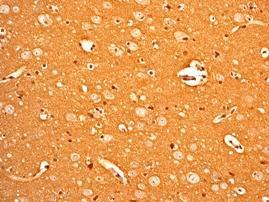
B. Immunohistochemical analysis of paraffin-embedded human brain tissue using anti-DJ-1 RabMAb (cat. # )Application
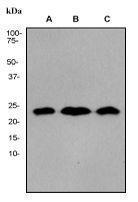
A. Western blot analysis on (A) TF-1 (B) Jurkat (C) HeLa cell lysates using anti-DJ-1 RabMAb (cat. # ) dilution 1:20000.| Product Name | Park7 / DJ-1 antibody , Internal |
|---|---|
| Antibody Type | Primary Antibodies |
| Product description | Rabbit monoclonal antibody [EP2816Y] to DJ-1DJ-1 is ubiquitously expressed in various human tissues, and expression is induced by growth stimuli. Moreover, DJ-1 translocates from cytoplasm to nuclei in the S phase of the cell cycle. DJ-1 is thus suggested to be a novel mitogen-dependent oncogene product involved in a Ras-related signal transduction pathway . DJ-1 was first identified as a novel candidate of the oncogene product that transformed mouse NIH3T3 cells in cooperation with an activated ras. Later DJ-1 was also found to be an infertility-related protein that was reduced in rat sperm treated with sperm toxicants that cause infertility in rats. Results of further tests indicate that DJ-1 is a positive regulator of the androgen receptor . Mutations in a gene on chromosome 1, DJ-1, have been reported recently to be associated with recessive, earlyonset Parkinson's disease. The L166P mutation has the simple effect of promoting DJ-1 degradation, thereby reducing net DJ-1 protein within the cell . |
| Immunogen | A synthetic peptide corresponding to residues near the internal region of human DJ-1 was used as an immunogen. |
| Clonality | Monoclonal |
|---|---|
| Isotype | IgG |
| Clone Number | EP2816Y |
| Host Species | Rabbit |
| Tested Applications | FACSICC/IFIHC-PWB |
| For WB: Use at a dilution of 1:10,000 - 20,000: |
|
| Species Reactivity | HumanMouseRat |
| Concentration | 1mg/ml |
| Gene Synonyms | FLJ27376 PARK7 DJ1 FLJ92274 DJ-1 FLJ34360 DJ 1 |
|---|---|
| Target | DJ-1 |
| Molecular Weight(MW) | 23 (note) |
Application
B. Immunohistochemical analysis of paraffin-embedded human brain tissue using anti-DJ-1 RabMAb (cat. # )
Application
A. Western blot analysis on (A) TF-1 (B) Jurkat (C) HeLa cell lysates using anti-DJ-1 RabMAb (cat. # ) dilution 1:20000.| Application Notes | For WB: Use at a dilution of 1:10,000 - 20,000: |
|---|
| Form | Liquid |
|---|---|
| Storage Instructions | Store at -20 °C. Stable for 12 months from date of receipt. |
| Storage Buffer | 50 mM Tris-Glycine (pH 7.4), 0.15 M NaCl, 40% Glycerol, 0.01% sodium azide and 0.05% BSA. |


