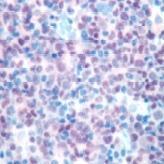
Application
staining PAX5 in human tonsil by Immunohistochemistry (FFPE-sections).Application
Human Tonsil stained with anti-PAX-5 antibody| Product Name | PAX5 antibody |
|---|---|
| Antibody Type | Primary Antibodies |
| Product description | Rabbit polyclonal to PAX5The PAX5 gene is a member of the paired box (PAX) family of transcription factors. The central feature of this gene family is a novel, highly conserved DNA-binding motif, known as the paired box. The PAX proteins are important regulators in early development, and alterations in the expression of their genes are thought to contribute to neoplastic transformation. The PAX5 gene encodes the B-cell lineage specific activator protein (BSAP) that is expressed at early, but not late stages of B-cell differentiation. Its expression has also been detected in developing CNS and testis, therefore, PAX5 gene product may not only play an important role in B-cell differentiation, but also in neural development and spermatogenesis. |
| Immunogen | Synthetic peptide from C-terminus of human Pax5 protein. (unfortunately, the amino acid sequence is considered to be commercially sensitive). |
| Clonality | Polyclonal |
|---|---|
| Isotype | IgG |
| Host Species | Rabbit |
| Tested Applications | IHC-FIHC-PWB |
| Immunohistology (Formalin/paraffin): Use at a dilution of 1/50 for 30 min at RT. Staining of formalin-fixed tissues requires boiling tissue sections in 10 mM citrate buffer, pH 6.0 for 10 min followed by cooling at RT for 20 min. WB: Use at an assay dependent dilution. Predicted molecular weight: 42 kDa. Optimal dilutions/concentrations should be determined by the end user.: |
|
| Species Reactivity | HumanMouseRat |
| Concentration | 0.2mg/ml |
| Purification | Affinity purified |
| Gene Synonyms | BSAP |
|---|---|
| Target | PAX5 |
| Cellular Localization | Nuclear |
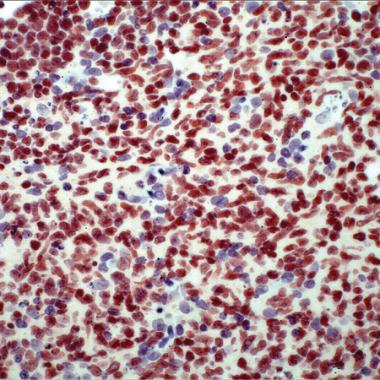
Application
staining PAX5 in human tonsil by Immunohistochemistry (FFPE-sections).
Application
Human Tonsil stained with anti-PAX-5 antibody| Positive Control | Tonsil |
|---|---|
| Application Notes | Immunohistology (Formalin/paraffin): Use at a dilution of 1/50 for 30 min at RT. Staining of formalin-fixed tissues requires boiling tissue sections in 10 mM citrate buffer, pH 6.0 for 10 min followed by cooling at RT for 20 min. WB: Use at an assay dependent dilution. Predicted molecular weight: 42 kDa. Optimal dilutions/concentrations should be determined by the end user.: |
| Form | Liquid |
|---|---|
| Storage Instructions | Keep as concentrated solution, aliquot and store at 4°C. Do not freeze. |
| Storage Buffer | Phosphate-buffered saline, pH 7.4 containing 1% BSA and 0.09% sodium azide |


