Application
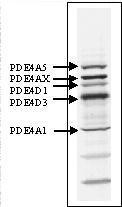
detecting 3 isoforms of PDE4A subclasses (PDE4A1, PDE4A5 and PDE4Ax),two isoforms of PDE4D (PDE4D1, PDE4D3) in rat brain by Western blot.Application
Western blot of PDE4 variants using PDE4 antibody| Product Name | PDE4 antibody |
|---|---|
| Antibody Type | Primary Antibodies |
| Product description | Rabbit polyclonal to PDE4The cAMP-specific Phosphodiesterase type 4 (PDE4) family is comprised of 4 genes (PDE4 A, B, C and D) with multiple splice variants generated by RNA splicing and use of alternate initiation sites. The cAMP-dependent protein kinase A modulates the enzyme activity of some PDE4 family members by phosphorylation / dephosphorylation mechanisms. Such short-term regulatory mechanisms are necessary for rapid changes in the cAMP levels in cells. PDE4 family selective inhibitor, rolipram inhibits all members of the PDE4 family. In rodents inhibition of PDE4 enzymes by rolipram attenuated short- and long-term memory impairment produced by the administration of scopolamine and MK801. Interaction of these enzymes with cellular scaffolding proteins plays important role in PDE4 compartmentalization and cAMP-dependent signaling. |
| Immunogen | Synthetic peptide (unfortunately, the amino acid sequence is considered to be commercially sensitive) C terminal. |
| Clonality | Polyclonal |
|---|---|
| Isotype | IgG |
| Host Species | Rabbit |
| Tested Applications | WB |
| WB: Use at an assay dependent dilution. Optimal dilutions/concentrations should be determined by the end user. | |
| Species Reactivity | HumanMouseRat |
| Concentration | 1mg/ml (Please refer to the vial label for the specific concentration) |
| Purification | Affinity purified |
| Gene Synonyms | Phosphodiesterase 4 |
|---|---|
| Target | PDE4 |
| Tissue Specificity | This antibody detects all known PDE4 A and D variants including PDE4A1, A5, Ax, A8 and PDE4D1-D5. It has low affinity for PDE4B variants. |
Application
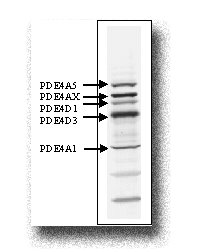
detecting 3 isoforms of PDE4A subclasses (PDE4A1, PDE4A5 and PDE4Ax),two isoforms of PDE4D (PDE4D1, PDE4D3) in rat brain by Western blot.
Application
Western blot of PDE4 variants using PDE4 antibody| Application Notes | WB: Use at an assay dependent dilution. Optimal dilutions/concentrations should be determined by the end user. |
|---|
| Form | Liquid |
|---|---|
| Storage Instructions | Keep as concentrated solution. Store at 4ºC short term. For extended storage aliquot and store at -20ºC or below. Avoid freeze-thaw cycles. |
| Storage Buffer | Preservative: 0.02% Thimerosal / Merthiolate |


