Application
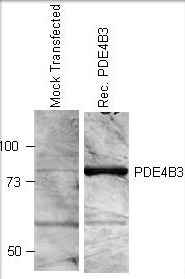
Western blot of PDE4B3 using mock transfected or PDE4B3 transfected Cos 1 cells. Light band in mock-transfected is endogeneous PDE4B3.| Product Name | PDE4B3 antibody |
|---|---|
| Antibody Type | Primary Antibodies |
| Product description | Rabbit polyclonal to PDE4B3Enzymes of the cAMP-dependent phosphodiesterase type 4 (PDE4) family are important in hydrolyzing cAMP produced by G-protein coupled receptor (GPCR) stimulated adenylyl cyclases. Four genes (PDE4A, B, C and D) make up the PDE4 family. cAMP-dependent phosphodiesterase type B (PDE4B) family is consists of 4 known splice variants, PDE4B1, B2, B3 and a novel 66 kDa PDE4B4 protein. One or more subtype variants of PDE4B are ubiquitously present in all mammalian cells. In CNS, all four PDE4B subtype variants are expressed in varying ratios and their activity is regulated in tandem with GPCRs stimulation. Some PDE4B variants are also substrate for PKA-dependent phosphorylation. |
| Immunogen | N-terminal and C-terminal peptide unique to PDE4B3 subtype variants. |
| Clonality | Polyclonal |
|---|---|
| Isotype | IgG |
| Host Species | Rabbit |
| Tested Applications | WB |
| WB: Use at a dilution of 1/500. Predicted molecular weight: 100 kDa. Optimal dilutions/concentrations should be determined by the end user.: |
|
| Species Reactivity | HumanMouseRat |
| Concentration | 1mg/ml |
| Purification | Affinity purified |
| Gene Synonyms | Phosphodiesterase Type 4B3 |
|---|---|
| Target | PDE4B3 |
| Tissue Specificity | Does not cross react with PDE4B1, PDE4B2 and PDE4B4 nor with PDE4A, PDE4C or PDE4D. |
Application
Western blot of PDE4B3 using mock transfected or PDE4B3 transfected Cos 1 cells. Light band in mock-transfected is endogeneous PDE4B3.| Application Notes | WB: Use at a dilution of 1/500. Predicted molecular weight: 100 kDa. Optimal dilutions/concentrations should be determined by the end user.: |
|---|
| Form | Liquid |
|---|---|
| Storage Instructions | Keep as concentrated solution. Store at 4ºC short term. For extended storage aliquot and store at -20ºC or below. Avoid freeze-thaw cycles. |
| Storage Buffer | Preservative: 0.02% Thimerosal / MerthiolateConstituents: 20% Glycerol, PBS |


