Application
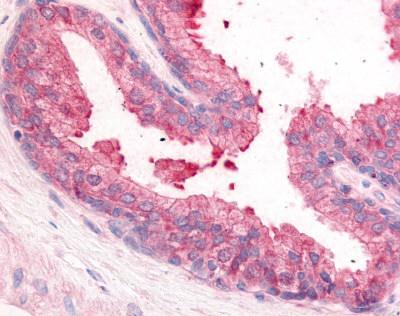
Human Prostate (formalin-fixed, paraffin-embedded) stained with PDE8A antibody at 10 ug/ml followed by biotinylated goat anti-rabbit IgG secondary antibody LS-D1, alkaline phosphatase-streptavidin and chromogen.| Product Name | PDE8A antibody |
|---|---|
| Antibody Type | Primary Antibodies |
| Product description | Rabbit polyclonal antibody to PDE8APhosphodiesterases (PDEs) regulate the intracellular levels of cAMP and cGMP. These cyclic nucleotides play an important role as second messengers in multiple physiologic processes, including regulation of vascular resistance, cardiac output, visceral motility, immune response, inflammation, neuroplasticity, vision, and reproduction. PDEs comprise a large superfamily of enzymes divided into 10 families. Different PDEs can be distinguished by their structure, tissue expression, localization, substrate specificity, regulation, and sensitivity to PDE inhibitors. Diversity in structure and specificity of function make PDEs promising targets for the pharmacotherapy of diseases modulated by cyclic nucleotide signaling (Hetman et al., MIM 2000). See MIM 171885.[supplied by OMIM] |
| Immunogen | Synthetic peptide - KLH conjugated |
| Clonality | Polyclonal |
|---|---|
| Host Species | Rabbit |
| Tested Applications | IHC-P |
| IHC-P (10 µg/ml): |
|
| Species Reactivity | Human |
| Concentration | 1mg/ml (Please refer to the vial label for the specific concentration) |
| Purification | Affinity purified |
| Gene Synonyms | FLJ16150 HsT19550 |
|---|---|
| Tissue Specificity | near N-terminus of human |
Application
Human Prostate (formalin-fixed, paraffin-embedded) stained with PDE8A antibody at 10 ug/ml followed by biotinylated goat anti-rabbit IgG secondary antibody LS-D1, alkaline phosphatase-streptavidin and chromogen.| Application Notes | IHC-P (10 µg/ml): |
|---|
| Form | Liquid |
|---|---|
| Storage Instructions | Long term: -70°C; Short term: +4°C |
| Storage Buffer | PBS, 0.1% sodium azide. |


