Application
ApplicationApplication
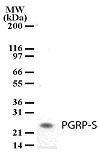
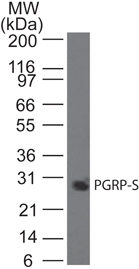
Western blot analysis using PGRP-S antibody. Lysate from human Jurkat cells probed with PGRP-S antibody at 2 ug/ml.| Product Name | PGRPS antibody |
|---|---|
| Antibody Type | Primary Antibodies |
| Product description | Mouse monoclonal [188C424] to PGRPSThe primary immune recognition is based on structures common among invading pathogens. Bacterial surface molecules, such as lipopolysaccharide (LPS) and peptidoglycan (PGN), are known to elicit immune reactions ranging from cytokine release to fever. Recently, a family of proteins called peptidoglycan recognition protein (PGRP) has been identified in mouse and human that binds to peptidoglycans expressed on Gram-positive bacteria. Peptidoglycan (PGN) is an essential cell wall component of virtually all bacteria and, thus, it is an excellent target for recognition by the eukaryotic innate immune system. The PGRPs (PGRP-L, PGRPS, PGRPIA, and PGRP-I-beta) define a new family of human pattern recognition molecules. PGRP-L is primarily expressed in the liver. Although liver is not considered a primary immune organ, liver participates in host defenses by producing acute phase proteins (by hepatocytes) in response to infections and by clearing microorganisms from blood. PGRPS is present in neutrophils and inhibits growth of Gram-positive bacteria and, therefore, may function as a neutrophil antibacterial protein. However, PGRPS may have another, as yet unidentified function because in humans it is expressed in the bone marrow 50100 times higher than in neutrophils. |
| Immunogen | Synthetic peptide: YVLKGHRDVQRTLSPG , corresponding to amino acids 165-180 of Human PGRPS. |
| Clonality | Monoclonal |
|---|---|
| Isotype | IgG1 |
| Clone Number | 188C424 |
| Host Species | Mouse |
| Tested Applications | WB |
| WB: Use at a concentration of 2 μg/ml. Predicted molecular weight: 22 kDa. Optimal dilutions/concentrations should be determined by the end user.: |
|
| Species Reactivity | Human |
| Concentration | 0.5mg/ml |
| Purification | Protein G |
| Gene Synonyms | MGC126894 MGC126896 PGLYRP PGRP PGRP-S PGRPS TAG7 TNFSF3L PGRP S |
|---|---|
| Target | PGRPS |
| Cellular Localization | Secreted |
Application
Application
Application
Western blot analysis using PGRP-S antibody. Lysate from human Jurkat cells probed with PGRP-S antibody at 2 ug/ml.| Positive Control | Tested with mouse spleen tissue |
|---|---|
| Application Notes | WB: Use at a concentration of 2 μg/ml. Predicted molecular weight: 22 kDa. Optimal dilutions/concentrations should be determined by the end user.: |
| Form | Liquid |
|---|---|
| Storage Instructions | Keep as concentrated solution. Store at 4ºC short term. For extended storage aliquot and store at -20ºC or below. Avoid freeze-thaw cycles. |
| Storage Buffer | Preservative: 0.02% Sodium Azide; Constituents: PBS |


