Application
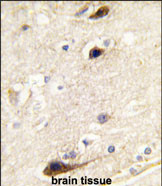
Formalin-fixed and paraffin-embedded human brain tissue reacted with PIP5K1B antibody (N-term) , which was peroxidase-conjugated to the secondary antibody, followed by DAB staining. This data demonstrates the use of this antibody for immunohistochemistry.Application
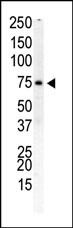
Western blot analysis of anti-PIP5K1B Pab in human placenta cell lysate. PIP5K1B (arrow) was detected using purified Pab. Secondary HRP-anti-rabbit was used for signal visualization with chemiluminescence.| Product Name | PIP5K1 beta antibody |
|---|---|
| Antibody Type | Primary Antibodies |
| Product description | Rabbit polyclonal to PIP5K1 betaProtein kinases are enzymes that transfer a phosphate group from a phosphate donor, generally the g phosphate of ATP, onto an acceptor amino acid in a substrate protein. By this basic mechanism, protein kinases mediate most of the signal transduction in eukaryotic cells, regulating cellular metabolism, transcription, cell cycle progression, cytoskeletal rearrangement and cell movement, apoptosis, and differentiation. With more than 500 gene products, the protein kinase family is one of the largest families of proteins in eukaryotes. The family has been classified in 8 major groups based on sequence comparison of their tyrosine (PTK) or serine/threonine (STK) kinase catalytic domains. |
| Immunogen | Synthetic peptide conjugated to KLH, corresponding to amino acids 1-18 of Human PIP5K1 B. |
| Clonality | Polyclonal |
|---|---|
| Isotype | IgG |
| Host Species | Rabbit |
| Tested Applications | IHC-PWB |
| For ELISA: Use at a dilution of 1:900 - 1:1,100. For IHC-F and IHC-P: Use at a dilution of 1:50 - 1:100. For WB: Use at a dilution of 1:100 - 1:500. Detects a band of approximately 61 kDa (predicted molecular weight: 64 kDa). Optimal dilutions/concentrations should be determined by the researcher. | |
| Species Reactivity | Human |
| Concentration | 0.2mg/ml |
| Purification | Protein G |
| Gene Synonyms | MSS4, STM7 |
|---|---|
| Target | PIP5K1 beta |
Application
Formalin-fixed and paraffin-embedded human brain tissue reacted with PIP5K1B antibody (N-term) , which was peroxidase-conjugated to the secondary antibody, followed by DAB staining. This data demonstrates the use of this antibody for immunohistochemistry.
Application
Western blot analysis of anti-PIP5K1B Pab in human placenta cell lysate. PIP5K1B (arrow) was detected using purified Pab. Secondary HRP-anti-rabbit was used for signal visualization with chemiluminescence.| Application Notes | For ELISA: Use at a dilution of 1:900 - 1:1,100. For IHC-F and IHC-P: Use at a dilution of 1:50 - 1:100. For WB: Use at a dilution of 1:100 - 1:500. Detects a band of approximately 61 kDa (predicted molecular weight: 64 kDa). Optimal dilutions/concentrations should be determined by the researcher. |
|---|
| Form | Liquid |
|---|---|
| Storage Instructions | Keep as concentrated solution. Store at 4ºC short term. For extended storage aliquot and store at -20ºC or below. Avoid freeze-thaw cycles. |
| Storage Buffer | Phosphate buffered saline containing 0.09% sodium azide |


