Application
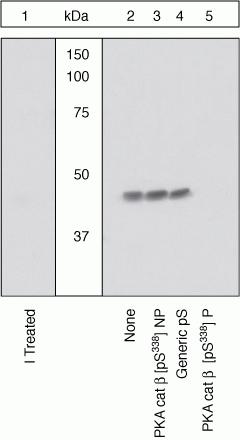
Lysates prepared from 3T3-L1 cells were resolved by SDS-PAGE on a 10% polyacrylamide gel and transferred to PVDF. Membranes were either treated with lambda phosphatase (1) or left untreated (2-5), blocked with a 5% BSA-TBST buffer for two hours at room temperature, and incubated with PKA cat beta [pS338] antibody for two hours at room temperature in a 3% BSA-TBST buffer, following prior incubation with: no peptide (1, 2), the non-phosphopeptide corresponding to the immunogen (3), a generic phosphoserine-containing peptide (4), or, the phosphopeptide immunogen (5). After washing, membranes were incubated with goat F(ab)2 anti-rabbit IgG HRP-conjugate and bands were detected. The data show that the peptide corresponding to PKA cat beta [pS338] blocks the antibody signal, thereby verifying the specificity of the antibody. The data also show that phosphatase stripping eliminates the signal, verifying that the antibody is phospho-specific.| Product Name | PKA beta (phospho Ser338) antibody |
|---|---|
| Antibody Type | Primary Antibodies |
| Product description | Rabbit polyclonal to PKA beta ( catalytic subunit ) ( phospho S338 )c-AMP-dependent Protein Kinase (PKA) is a serine/threonine kinase that regulates a number of cellular processes including proliferation, ion transport and gene transcription. PKA is composed of conserved catalytic subunits and regulatory subunits that dissociate upon activation by cAMP. The catalytic subunit of PKA contains the activation loop and mediates DNA binding and substrate recognition. The catalytic subunit is assembled and expressed as an active form and is phosphorylated on threonine 197 by PDK 1 in the activation loop and serine 338 in the carboxyl terminus. Phosphorylation of serine 338 plays a key role in stabilizing PKA and activating its substrates, and hence mediating its biological functions. |
| Immunogen | Synthetic phosphopeptide derived from a region of human PKA catalytic beta subunit that contains serine 338. |
| Modification | p-Ser338 |
| Clonality | Polyclonal |
|---|---|
| Isotype | IgG |
| Host Species | Rabbit |
| Tested Applications | WB |
| WB: Use at a dilution of 1/1000. Detects a band of approximately 42 kDa. Optimal dilutions/concentrations should be determined by the end user. | |
| Species Reactivity | HumanMousePigBovine |
| Concentration | 1mg/ml |
| Purification | Affinity purified |
| Gene Synonyms | DKFZp781I2452, MGC41879, MGC9320, PKACB, PKA beta (phospho S338), PKA beta (phospho Ser338), PKA beta (pS338), PKA beta (pSer338), PKA beta phospho S338, PKA beta phospho Ser338, Phospho PKA beta (S338), Phospho PKA beta (Ser338), Phospho PKA beta (pS338) |
|---|---|
| Target | PKA beta |
| Tissue Specificity | Peptide competition data indicate that this antibody cross-reacts with the PKA nu subunit (64% homologous) and partially with the alpha subunit (82% homologous). |
| Cellular Localization | Cytoplasmic and Nuclear |
Application
Lysates prepared from 3T3-L1 cells were resolved by SDS-PAGE on a 10% polyacrylamide gel and transferred to PVDF. Membranes were either treated with lambda phosphatase (1) or left untreated (2-5), blocked with a 5% BSA-TBST buffer for two hours at room temperature, and incubated with PKA cat beta [pS338] antibody for two hours at room temperature in a 3% BSA-TBST buffer, following prior incubation with: no peptide (1, 2), the non-phosphopeptide corresponding to the immunogen (3), a generic phosphoserine-containing peptide (4), or, the phosphopeptide immunogen (5). After washing, membranes were incubated with goat F(ab)2 anti-rabbit IgG HRP-conjugate and bands were detected. The data show that the peptide corresponding to PKA cat beta [pS338] blocks the antibody signal, thereby verifying the specificity of the antibody. The data also show that phosphatase stripping eliminates the signal, verifying that the antibody is phospho-specific.| Application Notes | WB: Use at a dilution of 1/1000. Detects a band of approximately 42 kDa. Optimal dilutions/concentrations should be determined by the end user. |
|---|
| Form | Liquid |
|---|---|
| Storage Instructions | Keep as concentrated solution. Store at 4ºC short term. For extended storage aliquot and store at -20ºC or below. Avoid freeze-thaw cycles. |
| Storage Buffer | Preservative: 0.05% Sodium Azide; Constituents: 50% Glycerol, PBS, 1mg/ml BSA. pH 7.3 |


