Application
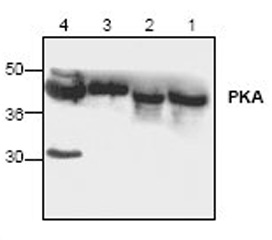
Western blots analysis of PKA expression in lysates from Jurkat cells (Lane 1 & 2), mouse small intestine (Lane 3), and rat kidney (Lane 4).| Product Name | PKA C alpha antibody |
|---|---|
| Antibody Type | Primary Antibodies |
| Product description | Rabbit polyclonal to PKA C alphaThe type 1(RI) and type 2 (RII) subunit of cyclic AMP-dependent protein kinase A (PKA) is a polyfunctional protein that is present in most tissues and cells. The many roles of RII include: 1) the regulation of extracellular cyclic AMP levels, 2) catalyzing the phosphorylation of the transcription factor CREB, 3) aiding in the development of mammalian oocytes and 4) phosphorylation of proteins to enhance the release of neurotransmitters. Localization of PKA is coordinated through association with A kinase anchoring proteins (AKAPs) that bind to a 14-18aa sequence in subunit RII |
| Immunogen | Synthetic peptide (residues 7-21) based on the human 40 kDa alpha isoform of the catalytic subunit of PKA. |
| Clonality | Polyclonal |
|---|---|
| Isotype | IgG |
| Host Species | Rabbit |
| Tested Applications | IPWB |
| WB: Use at a concentration of 1-2 μg/ml. IP: Use at a concentration of 20-30 μg/ml. Detects a band of approximately 40 kDa. Optimal dilutions/concentrations should be determined by the end user. | |
| Species Reactivity | HumanMouseRatBovine |
| Concentration | 0.5mg/ml |
| Purification | Affinity purified |
| Gene Synonyms | PKA, PKA C alpha, PRKACA, Protein kinase A catalytic subunit, PKACA, MGC102831, MGC48865 |
|---|---|
| Target | PKA |
| Tissue Specificity | Recongnizes a 40 kDa PKA on SDS-PAGE immunoblots. |
| Cellular Localization | Cytoplasmic (inactive holoenzyme and monomeric catalytic subunit). Translocates into the nucleus (monomeric catalytic subunit). |
Application
Western blots analysis of PKA expression in lysates from Jurkat cells (Lane 1 & 2), mouse small intestine (Lane 3), and rat kidney (Lane 4).| Application Notes | WB: Use at a concentration of 1-2 μg/ml. IP: Use at a concentration of 20-30 μg/ml. Detects a band of approximately 40 kDa. Optimal dilutions/concentrations should be determined by the end user. |
|---|
| Form | Liquid |
|---|---|
| Storage Instructions | Keep as concentrated solution. Store at 4ºC short term. For extended storage aliquot and store at -20ºC or below. Avoid freeze-thaw cycles. |
| Storage Buffer | PBS, pH 7.2, containing 50% glycerol, 1% BSA and 0.02% sodium azide. |


