Application
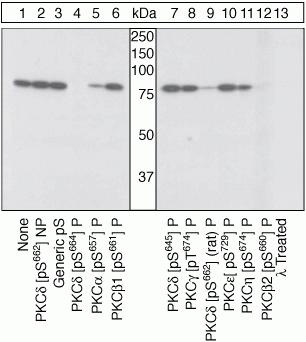
Lysates prepared from K562 cells stimulated with PMA were resolved by SDS-PAGE on a 10% polyacrylamide gel and transferred to PVDF. Membranes were either left untreated (1-12), or treated with lambda phosphatase (13), blocked with a 5% BSA-TBST buffer for one hour at room temperature, and incubated with PKCdelta [pS664] antibody for two hours at room temperature in a 3% BSA-TBST buffer, following prior incubation with: no peptide (1, 13), the non-phosphopeptide corresponding to the immunogen (2), a generic phosphoserine-containing peptide (3), the phosphopeptide immunogen (4), or the phosphopeptides corresponding to other PKC isoforms (5-12). After washing, membranes were incubated with goat F(ab)2 anti-rabbit IgG HRP conjugate and bands were detected. The data show that the peptide corresponding to PKCdelta [pS664] blocks the antibody signal. The peptide corresponding to PKCalpha [pS657] partially blocks the antibody signal, while those for PKCbetaII [pS660], and rat PKCdelta [pS662] block the antibody signal more thoroughly, indicating their respective reactivity with this antibody. The data also show that phosphatase stripping eliminates the signal, verifying that the antibody is phospho-specific| Product Name | PKC delta (phospho Ser664) antibody |
|---|---|
| Antibody Type | Primary Antibodies |
| Product description | Rabbit polyclonal to PKC delta ( phospho S664 )Protein Kinase C delta (PKC delta) is a 78 kDa member of the novel group (nPKCs: sensitive to diacylglycerol, phosphatidylserine, and phorbol esters) of the PKC family of serine/threonine kinases that are involved in a wide range of physiological processes including mitogenesis, cell survival and transcriptional regulation. PKC delta is an ubiquitously expressed PKC isozyme that has been implicated in the regulation of multiple cellular processes including cell cycle progression and apoptosis. Autophosphorylation of serine 664 (serine 662 in mouse and rat) contributes to PKC delta activity. Serum dependent phosphorylation of serine 664 is mediated by mTOR pathway, is protected from dephosphorylation by phosphorylated threonine 505 in the activation loop, and is implicated in prolactin signaling. |
| Immunogen | Synthetic phosphopeptide derived from a region of human PKC delta that contains serine 664. |
| Modification | p-Ser664 |
| Clonality | Polyclonal |
|---|---|
| Isotype | IgG |
| Host Species | Rabbit |
| Tested Applications | WB |
| WB: Use at a dilution of 1/1000. Detects a band of approximately 78 kDa. Optimal dilutions/concentrations should be determined by the end user. | |
| Species Reactivity | Human |
| Concentration | 1mg/ml |
| Purification | Affinity purified |
| Gene Synonyms | 2011/5/1, MGC49908, PKCD, nPKC-delta, nPKC delta, nPKCdelta, PKC delta (phospho S664), PKC delta (phospho Ser664), PKC delta (pS664), PKC delta (pSer664), PKC delta phospho S664, PKC delta phospho Ser664, Phospho PKC delta (S664), Phospho PKC delta (Ser66 |
|---|---|
| Target | PKC delta |
| Tissue Specificity | This antibody has been shown to cross-react with rat PKC alpha [pS657] (75% homologous) and PKC beta II [pS660] (67% homologous) shown by peptide competition experiments. Mouse PKC delta [pS662] (83% homologous) has not been tested, but is expected to react. |
| Cellular Localization | Cytoplasmic |
Application
Lysates prepared from K562 cells stimulated with PMA were resolved by SDS-PAGE on a 10% polyacrylamide gel and transferred to PVDF. Membranes were either left untreated (1-12), or treated with lambda phosphatase (13), blocked with a 5% BSA-TBST buffer for one hour at room temperature, and incubated with PKCdelta [pS664] antibody for two hours at room temperature in a 3% BSA-TBST buffer, following prior incubation with: no peptide (1, 13), the non-phosphopeptide corresponding to the immunogen (2), a generic phosphoserine-containing peptide (3), the phosphopeptide immunogen (4), or the phosphopeptides corresponding to other PKC isoforms (5-12). After washing, membranes were incubated with goat F(ab)2 anti-rabbit IgG HRP conjugate and bands were detected. The data show that the peptide corresponding to PKCdelta [pS664] blocks the antibody signal. The peptide corresponding to PKCalpha [pS657] partially blocks the antibody signal, while those for PKCbetaII [pS660], and rat PKCdelta [pS662] block the antibody signal more thoroughly, indicating their respective reactivity with this antibody. The data also show that phosphatase stripping eliminates the signal, verifying that the antibody is phospho-specific| Application Notes | WB: Use at a dilution of 1/1000. Detects a band of approximately 78 kDa. Optimal dilutions/concentrations should be determined by the end user. |
|---|
| Form | Liquid |
|---|---|
| Storage Instructions | Keep as concentrated solution. Store at 4ºC short term. For extended storage aliquot and store at -20ºC or below. Avoid freeze-thaw cycles. |
| Storage Buffer | Preservative: 0.05% Sodium Azide; Constituents: 50% Glycerol, PBS, 1mg/ml BSA (IgG, protease free). pH 7.3 |


