Application
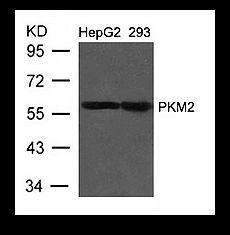
Western blot analysis of extracts from HepG2 and 293 cells using PKM1/2 Antibody .Application
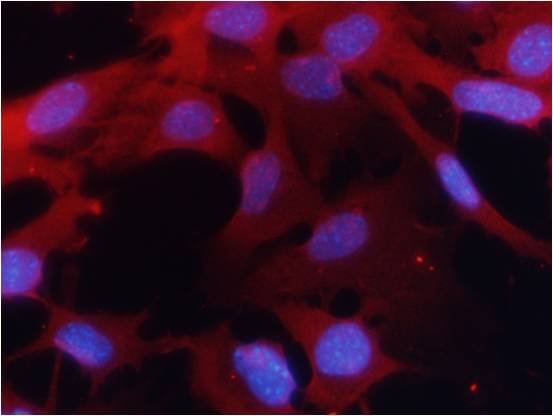
ICC/IF analysis of methanol-fixed MEF cells using PKM2 antibody (red) and DAPI (blue).| Product Name | PKM2 antibody |
|---|---|
| Antibody Type | Primary Antibodies |
| Product description | Rabbit Polyclonal antibody to PKM2Glycolytic enzyme that catalyzes the transfer of a phosphoryl group from phosphoenolpyruvate (PEP) to ADP, generating ATP. Stimulates POU5F1-mediated transcriptional activation. Plays a general role in caspase independent cell death of tumor cells. The ratio betwween the highly active tetrameric form and nearly inactive dimeric form determines whether glucose carbons are channeled to biosynthetic processes or used for glycolytic ATP production. The transition between the 2 forms contributes to the control of glycolysis and is important for tumor cell proliferation and survival. |
| Immunogen | Peptide sequence around aa.405~409(T-S-D-P-T) derived from Human PKM2. |
| Clonality | Polyclonal |
|---|---|
| Host Species | Rabbit |
| Tested Applications | ICC/IFWB |
| Suggested starting dilutions are as follows. WB: 1:500~1:1000. Not yet tested in other applications. Optimal working dilutions should be determined experimentally by the end user. | |
| Species Reactivity | Human |
| Concentration | 1mg/ml (Please refer to the vial label for the specific concentration) |
| Purification | Affinity purified |
| Gene Synonyms | CTHBP, MGC3932, OIP3, PK3, PKM, TCB, THBP1, PKM2, PK, muscle type, tumor M2-PK, OIP-3, pyruvate kinase 2/3, pyruvate kinase muscle isozyme, OPA-interacting protein 3, p58, pyruvate kinase isozymes M1/M2, thyroid hormone-binding protein 1, cytosolic thyroid |
|---|---|
| Target | PKM2 |
| Molecular Weight(MW) | 60 (note) |
| Tissue Specificity | This antibody was raised against a synthetic peptide corresponding to a region within aa 405-409 of human PKM2 (UniProt #P14618-1). Based on a BLAST result, it is specific for PKM2 and would not cross with PKM1. |
Application
Western blot analysis of extracts from HepG2 and 293 cells using PKM1/2 Antibody .
Application
ICC/IF analysis of methanol-fixed MEF cells using PKM2 antibody (red) and DAPI (blue).| Application Notes | Suggested starting dilutions are as follows. WB: 1:500~1:1000. Not yet tested in other applications. Optimal working dilutions should be determined experimentally by the end user. |
|---|
| Form | Liquid |
|---|---|
| Storage Instructions | Keep as concentrated solution. Aliquot and store at -20ºC or below. Avoid multiple freeze-thaw cycles. |
| Storage Buffer | saline (without Mg2+ and Ca2+), pH 7.4, 150mM NaCl, 0.02% sodium azide and 50% glycerol. |


