Application
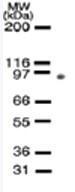
Western blot analysis of PMS2 using at 2 g/ml against 10 g of NIH 3T3 cell lysate.| Product Name | PMS2 antibody |
|---|---|
| Antibody Type | Primary Antibodies |
| Product description | Mouse monoclonal [163C1251] to PMS2Mismatch DNA repair in bacteria is carried out by the MutL, MutH, and MutS proteins. The MutS protein initially bunds to mismatched DNA. This is followed by binding of the MutH endonuclease and MutL to form a complex that carries out excision repair. The hMSH2 gene specifies a MutS homologue and hMLH1, hPMS1, and hPMS2 encode MutL homologs. Mutations in these genes are associated with hereditary nonpolyposis colon cancer (HNPCC), one of the most common hereditary diseases in man. As with the bacterial system, HNPCC is characterized by frequent microsatellite mutations that arise by somatic mutation due to a replication error (RER+) phenotype. Both hPMS1 and hPMS2 are mutated in the germline of HNPCC patients. Although the exact function of MutL and its homologs has yet to be determined, it is known that a complex of PMS2 and MLH1 (MutLa) from HeLa cells can complement a deficiency of MLH1 in hypermutable H6 colorectal tumor cells. |
| Immunogen | Synthetic peptide, Human. (unfortunately, the amino acid sequence is considered to be commercially sensitive) |
| Clonality | Monoclonal |
|---|---|
| Isotype | IgG1 |
| Clone Number | 163C1251 |
| Host Species | Mouse |
| Tested Applications | WB |
| WB: Use at a concentration of 1-2 μg/ml. Detects a band of approximately 85 kDa (predicted molecular weight: 103 kDa). Optimal dilutions/concentrations should be determined by the end user.: |
|
| Species Reactivity | Human |
| Concentration | 0.5mg/ml |
| Purification | Protein G |
| Gene Synonyms | HNPCC4 PMS2CL PMSL2 |
|---|---|
| Target | PMS2 |
| Cellular Localization | Nuclear |
Application
Western blot analysis of PMS2 using at 2 g/ml against 10 g of NIH 3T3 cell lysate.| Positive Control | Tested with NIH 3T3 and HCT-116 cell lysate |
|---|---|
| Application Notes | WB: Use at a concentration of 1-2 μg/ml. Detects a band of approximately 85 kDa (predicted molecular weight: 103 kDa). Optimal dilutions/concentrations should be determined by the end user.: |
| Form | Liquid |
|---|---|
| Storage Instructions | Keep as concentrated solution. Store at 4ºC short term. For extended storage aliquot and store at -20ºC or below. Avoid freeze-thaw cycles. |
| Storage Buffer | Preservative: 0.02% Sodium Azide; Constituents: PBS |


