Application
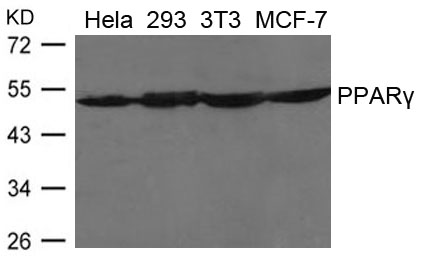
Western blot analysis of extracts from Hela, 293, 3T3 and MCF-7 cells using PPARg Antibody| Product Name | PPAR gamma antibody |
|---|---|
| Antibody Type | Primary Antibodies |
| Product description | Rabbit Polyclonal antibody to PPAR gammaReceptor that binds peroxisome proliferators such as hypolipidemic drugs and fatty acids. Once activated by a ligand, the receptor binds to a promoter element in the gene for acyl-CoA oxidase and activates its transcription. It therefore controls the peroxisomal beta-oxidation pathway of fatty acids. Key regulator of adipocyte differentiation and glucose homeostasis. |
| Immunogen | Peptide sequence around aa.50~54 (L-S-V-M-E) derived from Human PPAR gamma |
| Clonality | Polyclonal |
|---|---|
| Host Species | Rabbit |
| Tested Applications | WB |
| Suggested starting dilutions are as follows. WB: 1:500~1:1000. Not yet tested in other applications. Optimal working dilutions should be determined experimentally by the end user.: |
|
| Species Reactivity | HumanMouse |
| Concentration | 1mg/ml (Please refer to the vial label for the specific concentration) |
| Purification | Affinity purified |
| Gene Synonyms | CIMT1 GLM1 NR1C3 PPARG1 PPARG2 PPARgamma PPARG PPAR-gamma peroxisome proliferator-activated receptor gamma PPAR gamma nuclear receptor subfamily 1 group C member 3 peroxisome proliferator-activated nuclear receptor gamma variant 1 peroxisome p |
|---|---|
| Target | PPAR gamma |
| Molecular Weight(MW) | 53, 57 (note) |
| Tissue Specificity | it should react with human PPARG isoform1 and isoform 2 |
Application
Western blot analysis of extracts from Hela, 293, 3T3 and MCF-7 cells using PPARg Antibody| Application Notes | Suggested starting dilutions are as follows. WB: 1:500~1:1000. Not yet tested in other applications. Optimal working dilutions should be determined experimentally by the end user.: |
|---|
| Form | Liquid |
|---|---|
| Storage Instructions | Keep as concentrated solution. Aliquot and store at -20ºC or below. Avoid multiple freeze-thaw cycles. |
| Storage Buffer | saline (without Mg2+ and Ca2+), pH 7.4, 150mM NaCl, 0.02% sodium azide and 50% glycerol. |


