Application
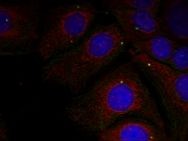
Immunofluorescence staining of methanol-fixed HeLa cells using α-Synuclein (Phospho-Tyr125).Application
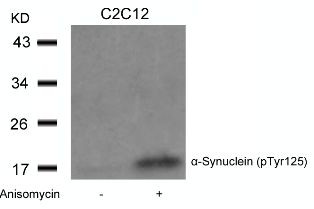
Western blot analysis of lysed extracts from C2C12 cells untreated or treated with Anisomycin using α-Synuclein (Phospho-Tyr125).| Product Name | a Synuclein (phospho Tyr125) Antibody |
|---|---|
| Antibody Type | Primary Antibodies |
| Antigen Alias | PD1, NACP, PARK1, PARK4, CD135, FLK2, STK1, SYN, SYUA, alpha-synuclein |
| Product description | SncA is a member of the synuclein family of structurally related proteins that are prominently expressed in the central nervous system, which also includes beta- and gamma-synuclein. Synucleins are abundantly expressed in the brain and SncA and Snc-Beta inhibit phospholipase D2 selectively. SncA may serve to integrate presynaptic signaling and membrane trafficking. Aggregated SncA proteins form brain lesions that are hallmarks of neurodegenerative synucleinopathies. Defects in SncA play a role in the pathogenesis of Parkinson disease. SncA peptides are a major component of amyloid plaques in the brains of patients with Alzheimer disease. SncA shares 95% sequence homology with rat SncA. Rat SncA is specifically expressed in brain and is associated with synaptosomal membranes in neurons1) Takahashi T, et al. J Biol Chem 2003 Oct 24; 278 (43): 42225-33Ahn BH, et al. J Biol Chem 2002 Apr 05; 277 (14): 12334-42Negro A, et al. FASEB J 2002 Feb; 16 (2): 210-2Goldberg, et al. Nat. Cell Biol. 2000; 2, 115-119. |
| Immunogen | a-Synuclein (Phospho-Tyr125) antibody was raised against a peptide sequence around phosphorylation site of tyrosine 125 (E-A-Y (p) -E-M) derived from Human α-Synuclein. |
| Modification | p-Tyr125 |
| Clonality | Polyclonal |
|---|---|
| Host Species | Rabbit |
| Tested Applications | IFWB |
| Western Blot: 1:500~1:1000, Immunofluorescence: 1:100~1:200: |
|
| Species Reactivity | Human |
| Concentration | 1mg/ml |
| Purification | Affinity purified |
| Gene Symbol | SNCA |
|---|---|
| Alternative Names | PD1 NACP PARK1 PARK4 CD135 FLK2 STK1 SYN SYUA alpha-synuclein |
| Molecular Weight(MW) | 18 kDa |
| Tissue Specificity | This antibody detects endogenous level of α-Synuclein only when phosphorylated at tyrosine 125. |
| Entrez Gene | 6622 |
|---|---|
| Protein Accession | NP_000336.1 |
Application
Immunofluorescence staining of methanol-fixed HeLa cells using α-Synuclein (Phospho-Tyr125).
Application
Western blot analysis of lysed extracts from C2C12 cells untreated or treated with Anisomycin using α-Synuclein (Phospho-Tyr125).| Application Notes | Western Blot: 1:500~1:1000, Immunofluorescence: 1:100~1:200: |
|---|
| Form | Liquid |
|---|---|
| Storage Instructions | Store antibody at -20˚C for up to one year. |
| Storage Buffer | Antibody supplied in phosphate buffered saline (without Mg2+ and Ca2+), pH 7.4, 150mM NaCl, 0.02% sodium azide and 50% glycerol. |


