Application
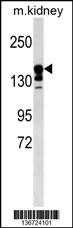
Western blot analysis in mouse kidney tissue lysates (35ug/lane).| Product Name | ABCC9 Antibody |
|---|---|
| Antibody Type | Primary Antibodies |
| Antigen Alias | ATP-binding cassette sub-family C member 9, Sulfonylurea receptor 2, ABCC9, SUR2 |
| Product description | The protein encoded by this gene is a member of the superfamily of ATP-binding cassette (ABC) transporters. ABC proteins transport various molecules across extra- and intra-cellular membranes. ABC genes are divided into seven distinct subfamilies (ABC1, MDR/TAP, MRP, ALD, OABP, GCN20, White). This protein is a member of the MRP subfamily which is involved in multi-drug resistance. This protein is thought to form ATP-sensitive potassium channels in cardiac, skeletal, and vascular and non-vascular smooth muscle. Protein structure suggests a role as the drug-binding channel-modulating subunit of the extrapancreatic ATP-sensitive potassium channels. No disease has been associated with this gene thus far. Alternative splicing of this gene results in several products, two of which result from differential usage of two terminal exons and one of which results from exon deletion.1) Bailey, S.D., et al. Diabetes Care 33(10):2250-2253(2010) |
| Immunogen | This ABCC9 antibody is generated from rabbits immunized with a KLH conjugated synthetic peptide between 640-669 amino acids from the Central region of human ABCC9. |
| Clonality | Polyclonal |
|---|---|
| Isotype | Ig |
| Host Species | Rabbit |
| Tested Applications | WB |
| For WB starting dilution is: 1:1000: |
|
| Species Reactivity | HumanMouse |
| Concentration | 1mg/ml |
| Purification | Affinity purified |
| Gene Symbol | ABCC9 |
|---|---|
| Alternative Names | ATP-binding cassette sub-family C member 9 Sulfonylurea receptor 2 ABCC9 SUR2 |
| Molecular Weight(MW) | 174 kDa |
Application
Western blot analysis in mouse kidney tissue lysates (35ug/lane).| Application Notes | For WB starting dilution is: 1:1000: |
|---|
| Form | Liquid |
|---|---|
| Storage Instructions | Store at 4˚C for three months and -20˚C, stable for up to one year. As with all antibodies care should be taken to avoid repeated freeze thaw cycles. Antibodies should not be exposed to prolonged high temperatures. |
| Storage Buffer | Supplied in PBS with 0.09% (W/V) sodium azide. |


