Application
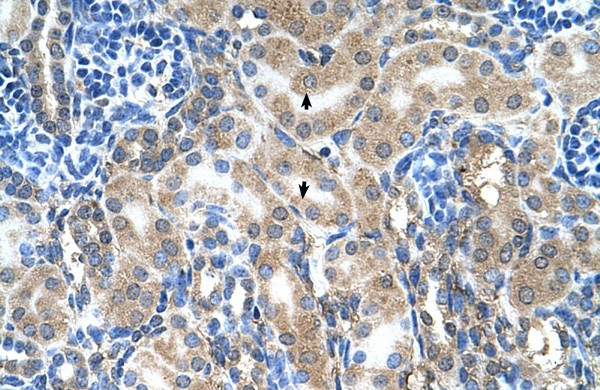
Antibody used in IHC on Human kidney at 4.0-8.0 ug/ml.Application
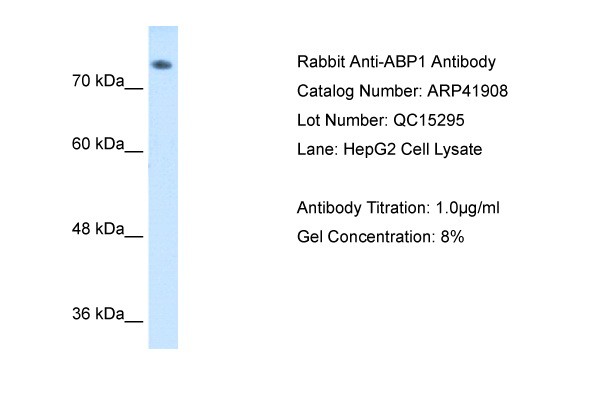
Antibody used in WB on Human HepG2 at 1 ug/ml.| Product Name | ABP1 Antibody |
|---|---|
| Antibody Type | Primary Antibodies |
| Antigen Alias | ABP1, ABP, AOC1, DAO, DAO1, KAO, ABP1 |
| Product description | ABP1 is a membrane glycoprotein that is expressed in many epithelium-rich and/or hematopoietic tissues and oxidatively deaminates putrescine and histamine. The protein may play a role in controlling the level of histamine and/or putrescine in these tissues. It also binds to and is inhibited by amiloride, a diuretic that acts by closing epithelial sodium ion channels.This gene encodes a membrane glycoprotein that is expressed in many epithelium-rich and/or hematopoietic tissues and oxidatively deaminates putrescine and histamine. The protein may play a role in controlling the level of histamine and/or putrescine in these tissues. It also binds to and is inhibited by amiloride, a diuretic that acts by closing epithelial sodium ion channels.1) Boomsma, F., (2005) Diabetologia 48 (5), 1002-1007. |
| Immunogen | Antibody produced in rabbits immunized with a synthetic peptide corresponding a region of human ABP1. |
| Clonality | Polyclonal |
|---|---|
| Host Species | Rabbit |
| Tested Applications | ELISAIHCWB |
| ABP1 antibody can be used for detection of ABP1 by ELISA at 1:312500. ABP1 antibody can be used for detection of ABP1 by western blot at 1.0 μg/mL, and HRP conjugated secondary antibody should be diluted 1:50,000 - 100,000.: |
|
| Species Reactivity | Human |
| Concentration | 1mg/ml |
| Purification | Affinity purified |
| Gene Symbol | AOC1 |
|---|---|
| Alternative Names | ABP1 ABP AOC1 DAO DAO1 KAO ABP1 |
| Molecular Weight(MW) | 83 kDa |
Application
Antibody used in IHC on Human kidney at 4.0-8.0 ug/ml.
Application
Antibody used in WB on Human HepG2 at 1 ug/ml.| Positive Control | 1) Cat. No. 1211 - HepG2 Cell Lysate |
|---|---|
| Application Notes | ABP1 antibody can be used for detection of ABP1 by ELISA at 1:312500. ABP1 antibody can be used for detection of ABP1 by western blot at 1.0 μg/mL, and HRP conjugated secondary antibody should be diluted 1:50,000 - 100,000.: |
| Form | Liquid |
|---|---|
| Storage Instructions | For short periods of storage (days) store at 4˚C. For longer periods of storage, store ABP1 antibody at -20˚C. As with any antibody avoid repeat freeze-thaw cycles. |
| Storage Buffer | Antibody is lyophilized in PBS buffer with 2% sucrose. Add 50 μL of distilled water. Final antibody concentration is 1 mg/mL. |


