Application
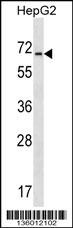
Western blot analysis in HepG2 cell line lysates (35ug/lane).| Product Name | ACCN4 Antibody |
|---|---|
| Antibody Type | Primary Antibodies |
| Antigen Alias | Acid-sensing ion channel 4, ASIC4, Amiloride-sensitive cation channel 4, Amiloride-sensitive cation channel 4, pituitary, ASIC4, ACCN4 |
| Product description | This gene belongs to the superfamily of acid-sensing ion channels, which are proton-gated, amiloride-sensitive sodium channels. These channels have been implicated in synaptic transmission, pain perception as well as mechanoperception. This gene is predominantly expressed in the pituitary gland, and was considered a candidate for paroxysmal dystonic choreoathetosis (PDC), a movement disorder, however, no correlation was found between mutations in this gene and PDC. Alternative splicing at this locus results in two transcript variants encoding different isoforms.1) Donier, E., et al. Eur. J. Neurosci. 28(1):74-86(2008) |
| Immunogen | This ACCN4 antibody is generated from rabbits immunized with a KLH conjugated synthetic peptide between 23-52 amino acids from the N-terminal region of human ACCN4. |
| Clonality | Polyclonal |
|---|---|
| Isotype | Ig |
| Host Species | Rabbit |
| Tested Applications | WB |
| For WB starting dilution is: 1:1000: |
|
| Species Reactivity | Human |
| Concentration | 1mg/ml |
| Purification | Affinity purified |
| Gene Symbol | ASIC4 |
|---|---|
| Alternative Names | Acid-sensing ion channel 4 ASIC4 Amiloride-sensitive cation channel 4 Amiloride-sensitive cation channel 4 pituitary ASIC4 ACCN4 |
| Molecular Weight(MW) | 70 kDa |
Application
Western blot analysis in HepG2 cell line lysates (35ug/lane).| Application Notes | For WB starting dilution is: 1:1000: |
|---|
| Form | Liquid |
|---|---|
| Storage Instructions | Store at 4˚C for three months and -20˚C, stable for up to one year. As with all antibodies care should be taken to avoid repeated freeze thaw cycles. Antibodies should not be exposed to prolonged high temperatures. |
| Storage Buffer | Supplied in PBS with 0.09% (W/V) sodium azide. |


