Application
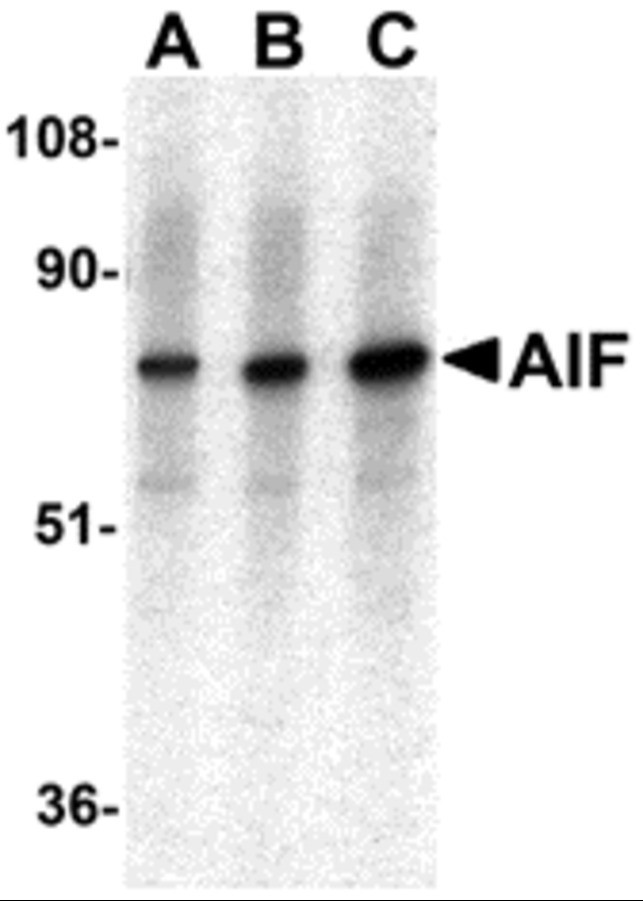
Western blot analysis of AIF in K562 with AIF antibody at (A) 0.5, (B) 1, and (C) 2 μg/mL.Application
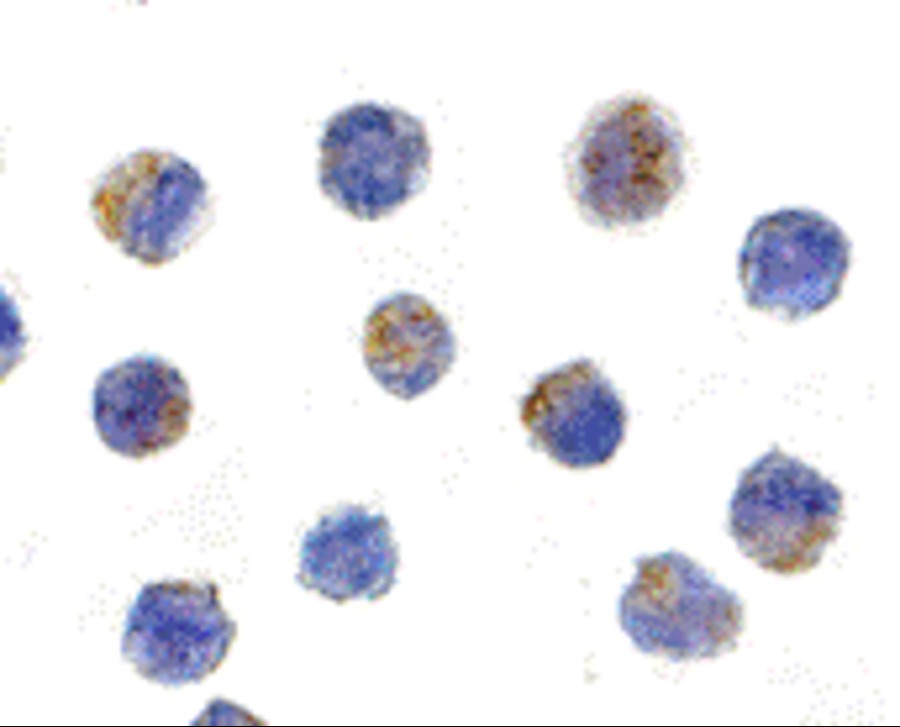
Immunocytochemistry of AIF in K562 cells with AIF antibody at 5 μg/mL.| Product Name | AIF Antibody |
|---|---|
| Antibody Type | Primary Antibodies |
| Antigen Alias | AIF Antibody: CNK, KSR, CNK1, Connector enhancer of kinase suppressor of ras 1, CNK homolog protein 1, Connector enhancer of KSR 1 |
| Product description | AIF Antibody: Apoptosis is characterized by several morphological nuclear changes including chromatin condensation and nuclear fragmentation. These changes are triggered by the activation of members of caspase family, caspase activated DNase, and several novel proteins. A novel gene, the product of which causes chromatin condensation and DNA fragmentation, was recently identified, cloned, and designated apoptosis inducing factor (AIF). Like the critical molecules, cytochrome c and caspase-9, in apoptosis, AIF localizes in mitochondria. AIF translocates to the nucleus when apoptosis is induced and induces mitochondria to release the apoptogenic proteins cytochrome c and caspase-9. AIF induces chromatin condensation and DNA fragmentation, which are the hallmarks of apoptosis, of the isolated nucleus and the nucleus in live cells by microinjection. AIF is highly conserved between human and mouse and widely expressed.1) Zamzami N, Kroemer G. Condensed matter in cell death. Nature 1999;401:127-8 |
| Immunogen | AIF antibody was raised against a 14 amino acid peptide near the carboxy terminus of human AIF. The immunogen is located within the last 50 amino acids of AIF. |
| Modification | Acetylated |
| Clonality | Polyclonal |
|---|---|
| Isotype | IgG |
| Host Species | Rabbit |
| Tested Applications | ELISAICC/IFWB |
| WB:1:500~1:2000 ICC/IF:1:100~1:500 |
|
| Species Reactivity | HumanMouseRat |
| Concentration | 1mg/ml |
| Purification | Affinity purified |
| Gene Symbol | CNKSR1 |
|---|---|
| Alternative Names | AIF Antibody: CNK KSR CNK1 Connector enhancer of kinase suppressor of ras 1 CNK homolog protein 1 Connector enhancer of KSR 1 |
| Molecular Weight(MW) | 67 kDa |
| Sequence Similarities | 4) Cat. No. 17-004 - K-562 Cell Slide |
Application
Western blot analysis of AIF in K562 with AIF antibody at (A) 0.5, (B) 1, and (C) 2 μg/mL.
Application
Immunocytochemistry of AIF in K562 cells with AIF antibody at 5 μg/mL.| Positive Control | 1) Cat. No. 1204 - K562 Cell Lysate |
|---|---|
| Application Notes | WB:1:500~1:2000 ICC/IF:1:100~1:500 |
| Form | Liquid |
|---|---|
| Storage Instructions | AIF antibody can be stored at 4˚C for three months and -20˚C, stable for up to one year. As with all antibodies care should be taken to avoid repeated freeze thaw cycles. Antibodies should not be exposed to prolonged high temperatures. |
| Storage Buffer | AIF Antibody is supplied in PBS containing 0.02% sodium azide. |


