Application
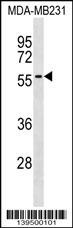
Western blot analysis in MDA-MB231 cell line lysates (35ug/lane).| Product Name | AKAP5 Antibody |
|---|---|
| Antibody Type | Primary Antibodies |
| Antigen Alias | A-kinase anchor protein 5, AKAP-5, A-kinase anchor protein 79 kDa, AKAP 79, H21, cAMP-dependent protein kinase regulatory subunit II high affinity-binding protein, AKAP5, AKAP79 |
| Product description | The A-kinase anchor proteins (AKAPs) are a group of structurally diverse proteins, which have the common function of binding to the regulatory subunit of protein kinase A (PKA) and confining the holoenzyme to discrete locations within the cell. This gene encodes a member of the AKAP family. The encoded protein binds to the RII-beta regulatory subunit of PKA, and also to protein kinase C and the phosphatase calcineurin. It is predominantly expressed in cerebral cortex and may anchor the PKA protein at postsynaptic densities (PSD) and be involved in the regulation of postsynaptic events. It is also expressed in T lymphocytes and may function to inhibit interleukin-2 transcription by disrupting calcineurin-dependent dephosphorylation of NFAT.1) Willoughby, D., et al. J. Biol. Chem. 285(26):20328-20342(2010) |
| Immunogen | This AKAP5 antibody is generated from rabbits immunized with a KLH conjugated synthetic peptide between 115-143 amino acids from the Central region of human AKAP5. |
| Clonality | Polyclonal |
|---|---|
| Isotype | Ig |
| Host Species | Rabbit |
| Tested Applications | WB |
| For WB starting dilution is: 1:1000: |
|
| Species Reactivity | Human |
| Concentration | 1mg/ml |
| Purification | Affinity purified |
| Gene Symbol | AKAP5 |
|---|---|
| Alternative Names | A-kinase anchor protein 5 AKAP-5 A-kinase anchor protein 79 kDa AKAP 79 H21 cAMP-dependent protein kinase regulatory subunit II high affinity-binding protein AKAP5 AKAP79 |
| Molecular Weight(MW) | 47 kDa |
Application
Western blot analysis in MDA-MB231 cell line lysates (35ug/lane).| Application Notes | For WB starting dilution is: 1:1000: |
|---|
| Form | Liquid |
|---|---|
| Storage Instructions | Store at 4˚C for three months and -20˚C, stable for up to one year. As with all antibodies care should be taken to avoid repeated freeze thaw cycles. Antibodies should not be exposed to prolonged high temperatures. |
| Storage Buffer | Supplied in PBS with 0.09% (W/V) sodium azide. |


