Application
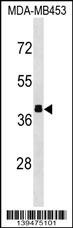
Western blot analysis in MDA-MB453 cell line lysates (35ug/lane).This demonstrates the ALDOB antibody detected the ALDOB protein (arrow).| Product Name | ALDOB Antibody |
|---|---|
| Antibody Type | Primary Antibodies |
| Antigen Alias | Fructose-bisphosphate aldolase B, Liver-type aldolase, ALDOB, ALDB |
| Product description | Fructose-1,6-bisphosphate aldolase (EC 4.1.2.13) is a tetrameric glycolytic enzyme that catalyzes the reversible conversion of fructose-1,6-bisphosphate to glyceraldehyde 3-phosphate and dihydroxyacetone phosphate. Vertebrates have 3 aldolase isozymes which are distinguished by their electrophoretic and catalytic properties. Differences indicate that aldolases A, B, and C are distinct proteins, the products of a family of related 'housekeeping' genes exhibiting developmentally regulated expression of the different isozymes. The developing embryo produces aldolase A, which is produced in even greater amounts in adult muscle where it can be as much as 5% of total cellular protein. In adult liver, kidney and intestine, aldolase A expression is repressed and aldolase B is produced. In brain and other nervous tissue, aldolase A and C are expressed about equally. There is a high degree of homology between aldolase A and C. Defects in ALDOB cause hereditary fructose intolerance. [provided by RefSeq].1) Bouteldja, N., et al. J. Inherit. Metab. Dis. 33(2):105-112(2010) |
| Immunogen | This ALDOB antibody is generated from rabbits immunized with a KLH conjugated synthetic peptide between 31-60 amino acids from the N-terminal region of human ALDOB. |
| Clonality | Polyclonal |
|---|---|
| Isotype | Ig |
| Host Species | Rabbit |
| Tested Applications | WB |
| For WB starting dilution is: 1:1000: |
|
| Species Reactivity | Human |
| Concentration | 1mg/ml |
| Purification | Affinity purified |
| Gene Symbol | ALDOB |
|---|---|
| Alternative Names | Fructose-bisphosphate aldolase B Liver-type aldolase ALDOB ALDB |
| Molecular Weight(MW) | 39 kDa |
| Sequence Similarities | Predicted species reactivity based on immunogen sequence: Bovine |
Application
Western blot analysis in MDA-MB453 cell line lysates (35ug/lane).This demonstrates the ALDOB antibody detected the ALDOB protein (arrow).| Application Notes | For WB starting dilution is: 1:1000: |
|---|
| Form | Liquid |
|---|---|
| Storage Instructions | Store at 4˚C for three months and -20˚C, stable for up to one year. As with all antibodies care should be taken to avoid repeated freeze thaw cycles. Antibodies should not be exposed to prolonged high temperatures. |
| Storage Buffer | Supplied in PBS with 0.09% (W/V) sodium azide. |


