Application
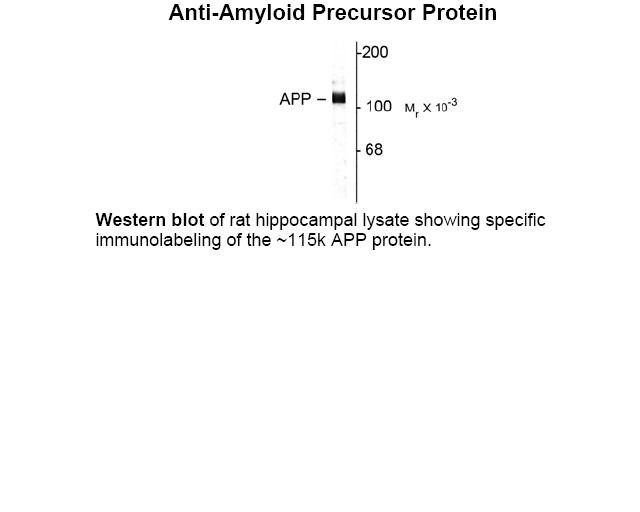
Western blot of rat hippocampal lysate showing specific immunolabeling of the ~115k APP protein.| Product Name | Amyloid Precursor Protein Antibody |
|---|---|
| Antibody Type | Primary Antibodies |
| Antigen Alias | Abeta, ABPP, APP |
| Product description | A large body of evidence has implicated the amyloid precursor protein (APP) in the pathogenesis of Alzheimer's disease (AD) (Kamenetz et al., 2003). The phosphorylation of APP at Thr668 is thought to play a critical role in generation of the soluble APP (beta) and beta-amyloid peptide (abeta) which are the major components of senile plaques in patient brains inflicted with AD (Liu et al., 2003; Ando et al., 2001).1) Ando K, Iijima KI, Elliott JI, Kirino Y, Suzuki T (2001) Phosphorylation-dependent regulation of the interaction of amyloid precursor protein with Fe65 affects the production of beta-amyloid. J Biol Chem 276:40353-40361. |
| Immunogen | Peptide corresponding to amino acid residues from the C-terminal region of rat APP. |
| Clonality | Polyclonal |
|---|---|
| Host Species | Rabbit |
| Tested Applications | WB |
| The antibody has been directly tested for reactivity in rat tissue. It is anticipated that the antibody will also work with canine, chicken, human, mouse and non-human primate tissues based on the fact that these species have 100% homology with the amino acid sequence used as antigen.: |
|
| Species Reactivity | DogHumanMouseRat |
| Concentration | 1mg/ml |
| Purification | Affinity purified |
| Gene Symbol | App |
|---|---|
| Alternative Names | Abeta ABPP APP |
| Molecular Weight(MW) | 115 |
Application
Western blot of rat hippocampal lysate showing specific immunolabeling of the ~115k APP protein.| Application Notes | The antibody has been directly tested for reactivity in rat tissue. It is anticipated that the antibody will also work with canine, chicken, human, mouse and non-human primate tissues based on the fact that these species have 100% homology with the amino acid sequence used as antigen.: |
|---|
| Form | Liquid |
|---|---|
| Storage Instructions | Amyloid Precursor Protein antibody can be stored at -20˚C and is stable at -20˚C for at least 1 year. |
| Storage Buffer | 100 uL in 10 mM HEPES (pH 7.5), 150 mM NaCl, 100 ug per mL BSA and 50% glycerol. |


