Application
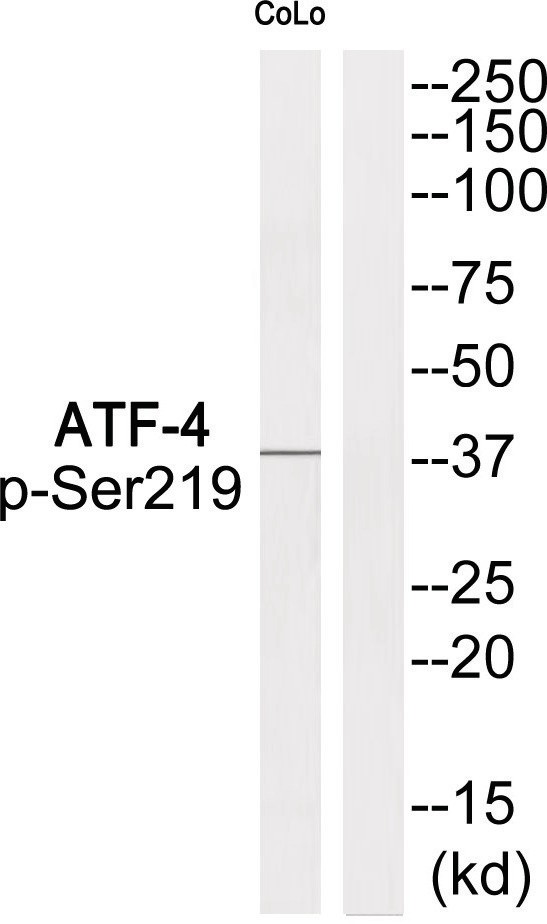
Western blot analysis of extracts from COLO cells using ATF-4 (Phospho-Ser219) Antibody. The lane on the right is treated with the antigen-specific peptide.| Product Name | ATF-4 (phospho Ser219) Antibody |
|---|---|
| Antibody Type | Primary Antibodies |
| Antigen Alias | ATF4, CREB-2, DNA-binding protein TAXREB67, TXREB |
| Product description | ATF4 encodes a transcription factor that was originally identified as a widely expressed mammalian DNA binding protein that could bind a tax-responsive enhancer element in the LTR of HTLV-1. The encoded protein was also isolated and characterized as the cAMP-response element binding protein 2 (CREB-2). The protein encoded by this gene belongs to a family of DNA-binding proteins that includes the AP-1 family of transcription factors, cAMP-response element binding proteins (CREBs) and CREB-like proteins. These transcription factors share a leucine zipper region that is involved in protein-protein interactions, located C-terminal to a stretch of basic amino acids that functions as a DNA binding domain. Two alternative transcripts encoding the same protein have been described. Two pseudogenes are located on the X chromsome at q28 in a region containing a large inverted duplication.1) Sato T., Shimotohno K. J. Virol. 65:1420-1426(1991) |
| Immunogen | ATF-4 (phospho Ser219) antibody was raised against a peptide sequence around phosphorylation site of Serine 219 (N-D-S (p)-G-T) derived from Human ATF-4. |
| Modification | p-Ser219 |
| Clonality | Polyclonal |
|---|---|
| Isotype | IgG |
| Host Species | Rabbit |
| Tested Applications | WB |
| Western Blot: 1:500~1:1000: |
|
| Species Reactivity | HumanMouse |
| Concentration | 1mg/ml |
| Purification | Affinity purified |
| Gene Symbol | ATF4 |
|---|---|
| Alternative Names | ATF4 CREB-2 DNA-binding protein TAXREB67 TXREB |
| Molecular Weight(MW) | 38 kDa |
| Tissue Specificity | The Antibody detects endogenous levels of ATF-4 only when phosphorylated at Serine 219. |
| Entrez Gene | 468 |
|---|---|
| Protein Accession | NP_001666.2 |
Application
Western blot analysis of extracts from COLO cells using ATF-4 (Phospho-Ser219) Antibody. The lane on the right is treated with the antigen-specific peptide.| Application Notes | Western Blot: 1:500~1:1000: |
|---|
| Form | Liquid |
|---|---|
| Storage Instructions | Store antibody at -20˚C for up to one year. |
| Storage Buffer | Antibody supplied in phosphate buffered saline (without Mg2+ and Ca2+), pH 7.4, 150mM NaCl, 0.02% sodium azide and 50% glycerol. |


