Application
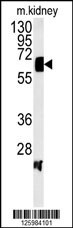
Western blot analysis of ATP6V1H Antibody in mouse kidney tissue lysates (35ug/lane)| Product Name | ATP6V1H Antibody |
|---|---|
| Antibody Type | Primary Antibodies |
| Antigen Alias | V-type proton ATPase subunit H, V-ATPase subunit H, Nef-binding protein 1, NBP1, Protein VMA13 homolog, V-ATPase 50/57 kDa subunits, Vacuolar proton pump subunit H, Vacuolar proton pump subunit SFD, ATP6V1H |
| Product description | ATP6V1H encodes a component of vacuolar ATPase (V-ATPase), a multisubunit enzyme that mediates acidification of eukaryotic intracellular organelles. V-ATPase dependent organelle acidification is necessary for such intracellular processes as protein sorting, zymogen activation, receptor-mediated endocytosis, and synaptic vesicle proton gradient generation. V-ATPase is composed of a cytosolic V1 domain and a transmembrane V0 domain. The V1 domain consists of three A and three B subunits, two G subunits plus the C, D, E, F, and H subunits. The V1 domain contains the ATP catalytic site. The V0 domain consists of five different subunits: a, c, c', c', and d. Additional isoforms of many of the V1 and V0 subunit proteins are encoded by multiple genes or alternatively spliced transcript variants. This gene encodes the regulatory H subunit of the V1 domain which is required for catalysis of ATP but not the assembly of V-ATPase.1) Fuster, D.G., et al. Kidney Int. 73(10):1151-1158(2008) |
| Immunogen | This ATP6V1H antibody is generated from rabbits immunized with a KLH conjugated synthetic peptide between 400-426 amino acids from the C-terminal region of human ATP6V1H. |
| Clonality | Polyclonal |
|---|---|
| Isotype | Ig |
| Host Species | Rabbit |
| Tested Applications | WB |
| For WB starting dilution is: 1:1000: |
|
| Species Reactivity | HumanMouse |
| Concentration | 1mg/ml |
| Purification | Affinity purified |
| Gene Symbol | ATP6V1H |
|---|---|
| Alternative Names | V-type proton ATPase subunit H V-ATPase subunit H Nef-binding protein 1 NBP1 Protein VMA13 homolog V-ATPase 50/57 kDa subunits Vacuolar proton pump subunit H Vacuolar proton pump subunit SFD ATP6V1H |
| Molecular Weight(MW) | 56 kDa |
| Sequence Similarities | Predicted species reactivity based on immunogen sequence: Bovine |
Application
Western blot analysis of ATP6V1H Antibody in mouse kidney tissue lysates (35ug/lane)| Application Notes | For WB starting dilution is: 1:1000: |
|---|
| Form | Liquid |
|---|---|
| Storage Instructions | Store at 4˚C for three months and -20˚C, stable for up to one year. As with all antibodies care should be taken to avoid repeated freeze thaw cycles. Antibodies should not be exposed to prolonged high temperatures. |
| Storage Buffer | Supplied in PBS with 0.09% (W/V) sodium azide. |


